
Showing posts with label John Terry. Show all posts
Showing posts with label John Terry. Show all posts
Friday, 27 December 2013
I See You
Here's another recording. John Terry reads his poem 'I See You', and then tells the story behind how he wrote it.
The weather vane in the picture is a gudgeon, and it's on the little jail in the middle of the bridge at Bradford on Avon. I was looking at pictures of the bridge on the BBC website yesterday; with the recent floods, great trunks of trees had become wedged against the piers, and workers were doing their best to haul them up.


Friday, 20 December 2013
Inking Bitterns on BBC Radio Bristol with Steve Yabsley

Deborah Harvey, John Terry and I were on Steve Yabsley's afternoon show on BBC Radio Bristol, talking about our book Inking Bitterns - poems and pictures for wild places. We talked for half an hour, and each read two of our poems. We also managed to discuss Morris Minors, skip-diving, seafaring, gender transitioning, and poetry in general. It was quite a wide-ranging discussion!
Radio has been described as a very visual medium, but even so, you would not have been able to see the pictures that went with the poems, just by listening to the interview - which you can hear as a podcast HERE (We are on about 30 minutes into the programme, just after the Beatles track!)
So here are the pictures and the poems that we read, together as they are in the book. Click on the images to see them larger. By the way, as I said on the programme, we are not selling through Amazon; but you can get it at Gert Macky, and all (well, some. Not many yet TBH) good book shops.


Thursday, 2 August 2012
cat sighs

cat sighs, originally uploaded by Dru Marland.
Cat sighs – and so would you,stuck in the road where cars go throughwith fat black tyres to squash them flat.But they 're hardly ever put out by that,they sighs a few sighswipes both eyesthen springs back to life like a cartoon cat..
John Terry*
Admiring Steve Marland's collages this morning, I recalled this one of mine from a few years ago. And since I've been doing a fair bit of travelling lately, here it is again. Life on the road.
*John wrote this in response to the photo, and e-mailed it to me just then. So I've added it here, because I like it. Thanks, John!
*John wrote this in response to the photo, and e-mailed it to me just then. So I've added it here, because I like it. Thanks, John!
Wednesday, 9 May 2012
I see you
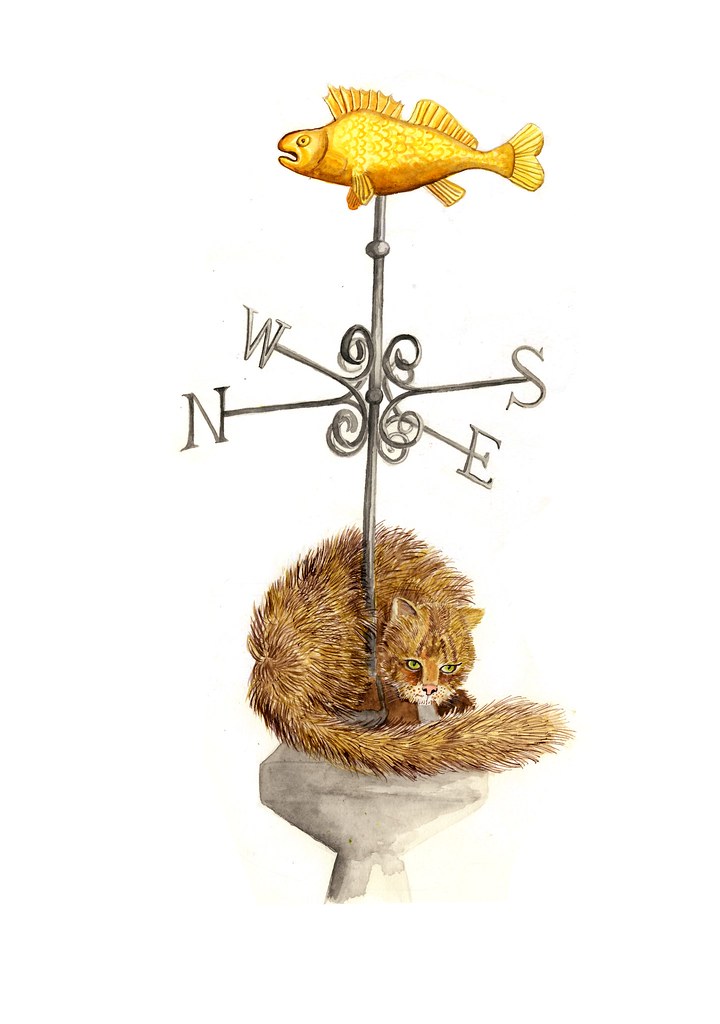
I see you, says the shivering cat
to the wind that ruffles her fur.
Your fingers are blue, your face is fat
and you rush around without a hat.
I see you, says the shivering cat,
and turns her back and will not purr.
I see you, says the shivering cat,
to the wind that ruffles her fur.
Picking Katie up from a party the other day, her friend's mother said "Do you know a poet called John Terry ?"
I admitted that I do indeed know him.
They'd been Googling him, and found my pictures on Flickr.
They told me the story about why they'd been Googling for John.
Ten years ago, young L had asked "Can cats see the wind?"
This question was passed on to John, and he wrote this poem.
It is a nice story, and a nice poem, so I did this picture for it. The weather vane with a gudgeon on it is in Bradford on Avon, on the roof of the lock-up in the middle of the bridge over the Avon; I got the idea for that from Bella, who painted another weather vane in B-on-A the other day.
Monday, 11 January 2010
a big snowman
 John Terry, whose book of poems, Building Wings, came out recently, sent me this poem he wrote a few years ago after seeing my previous photo of Katie on a snowball. So here it is
A True Story
When I was five my dad showed me
how a snowball rolled in snow gets bigger.
So I rolled my snowball in the snow
until it was too big for me to move.
Then I called my friends to help
and we rolled our snowball in the snow
until it was too big for us to move.
Then my dad came out to help
and he rolled our snowball in the snow
until it was too big for him to move.
Then we called my uncle to help
and we all rolled our snowball in the snow
until it was too big for anyone to move.
It was so big
we made it into a snowman,
with a carroty nose and potato eyes,
a tattered scarf, and a broom to lean on.
He was so big
that when the snow melted
he took a whole week to run away,
and even then,
left the broom and scarf behind.
But I do know he took his carroty nose
and potato eyes with him.
Because when I looked,
they'd gone.
Wednesday, 30 September 2009
Hardbacks
What with all the talk of libraries and classification lately, here's an apposite poem from John Terry.
Hardbacks
The books you’ve requested
are certainly here – but since
our Index altered itself
the stock moves at random.
Whole shelves of books
will vanish, then reappear
in a different section. You
have entered an area
where high Index numbers
frequently auto-accelerate
beyond their Critical Library
Mark. You can expect Flutter,
Disordered Page Syndrome
and complete Control Reversal.
Our librarians are fully trained
in runaway system management,
but Health and Safety insist
that borrowers must wear
protective dust-jackets at all times.
Some of our more rugged volumes
will not hesitate to read you like a book.
Saturday, 12 September 2009
building wings

I knew this chap who could slaughter a pig, play the flute, quote by heart from Joyce. Oh, and he was the Chief Engineer on the ferry I was working on, too. But he was Irish. English engineers are usually a bit more philistine, in my experience.
Well, English people generally, I suppose.
John Terry, on the other hand, is a precision engineer who used to build wings for aeroplanes. And he's a poet, and all-round Good Sort.
We were down at the Arnolfini the other evening, for the launch of his new book. And a very good evening it was too (though Katie was drooping by eleven o'clock; it's hard to keep up when you're mixing with people who are mad, bad and/or dangerous to know...). John shared the evening with Penelope Shuttle, Esther Morgan, and Gwen Seaborne, so there was a lot of poetry around.
Oh, and Katie designed the cover. She was given a round of applause too!
Here's one of John's poems.
South
At least once a week, every week for years,
she'd kept on at him to clear the garage:
until one day he locked its up-and-over
from the inside and she heard the sound
of hammering, the clatter of metal,
the sudden shriek of his drill; the beaten
echoes of her own fist on the tarnished
aluminium he'd always refused to paint.
The familiar lock rejected her key
as if she were a stranger. He never spoke,
not even to swear, never sang or whistled –
ignored the food she began to leave outside,
tapping lightly on the aluminium,
her fists grown too sore for aggression.
As winter approached she started to beg:
the house was lonely, the garage unheated.
How could he prefer concrete and the Flymo
to their Slumberland, her flesh under the duvet
yearning now as it hadn't done for years –
heart beating like a Bosch hammer drill,
her nagging complaints filed down to trivia.
When all sound ceased on Christmas eve,
and nine hundred and ninety-nine police
forced open the door, they found a pair
of delicate butterfly wings, cunningly
fashioned from junk and pieces of the Flymo
with the word 'Hers' worked into the pattern.
There was a marked chart of migration routes;
and clear evidence that similar wings
had clipped the lilac as they flew away.
After the police had gone she scribbled a note
for the milkman, folded the chart to its first
section, and left the suburbs; flying up
through the gap in the lilac, heading south.
Subscribe to:
Posts (Atom)