
In the oak's shadow
the sheltering sheep tell the time
-too hot to go out

Thursday, 18 July 2013


Monday, 15 July 2013
the Cliftonwood rainbow
...a row of houses overlooking Bristol Harbour. I think this was the first terrace in Bristol to go multicoloured. Presumably, somebody once thought "I'll paint the house a cheerful colour" and then the neighbours saw it and thought "Oh, good idea..."
There's a newly built development just below here which was painted multicoloured from the start. Which seems a bit cheaty.

There's a newly built development just below here which was painted multicoloured from the start. Which seems a bit cheaty.
Saturday, 13 July 2013
death and the seagull
The first flight of swifts curved over the gardens, then burst into five directions. Two of them whizzed close over my head, the beat of their wings shushing like little Coronation Scots.
The city's blackbirds sang a backing track to the woodpigeon's latest song, the Too Stewed Blues. To be honest, it sounded quite similar to its last song. There were occasional quarrels from the magpies, and two crows tumbled over, squabbling as they went.
Angry Seagull just stood there, idly adjusting his feathers. Two days ago he'd have been flying at my head, making a damn nuisance of himself. But then Irritating Little Seagull fell into the road.


Angry Seagull went into a frenzy of divebombing anyone who ventured out, especially if they had a dog.

"Someone's called the Council," said the postie as he scurried by, waving his hat.
"I hope they kill the bugger," I replied.
Mandy from over the road put out some water and some meat. Sharon said that they'd been wondering how to get it back on the roof. I reckoned that Garden Fox would deal with the Seagull Question before the next morning.
And so, it seems, it has.

The city's blackbirds sang a backing track to the woodpigeon's latest song, the Too Stewed Blues. To be honest, it sounded quite similar to its last song. There were occasional quarrels from the magpies, and two crows tumbled over, squabbling as they went.
Angry Seagull just stood there, idly adjusting his feathers. Two days ago he'd have been flying at my head, making a damn nuisance of himself. But then Irritating Little Seagull fell into the road.


Angry Seagull went into a frenzy of divebombing anyone who ventured out, especially if they had a dog.

"Someone's called the Council," said the postie as he scurried by, waving his hat.
"I hope they kill the bugger," I replied.
Mandy from over the road put out some water and some meat. Sharon said that they'd been wondering how to get it back on the roof. I reckoned that Garden Fox would deal with the Seagull Question before the next morning.
And so, it seems, it has.
Friday, 12 July 2013
A wing and a prayer

We must have reached at least 65mph on that long downhill from the Thornbury motorway interchange. The Severn Bridge loomed ahead, and Katie had rummaged in my bag just in time to muster the toll.
There was a momentary faltering of the engine.
We exchanged glances. And carried on. "Faith et blind hope", I thought to myself.
Through the toll gate and ascending the long curve of the bridge, the engine faltered some more.
"Kick the bulkhead, will you?" I said.
Katie obliged. She's quite practiced at this. There was a time when the fuel pump was a bit unreliable, and was frequently revived with a judicious thumping on the bulkhead forward of the passenger seat.
"Well, that seems to help," I said.
"Certainly helps me," she replied. Katie is immune to the subtle charm of old Morrises.
We made it, and spluttered our way through Chepstow and over the old iron bridge, then up the steep hill and north to Tidenham, where the engine finally conked. I stripped down the carburettor; the petrol in the float bowl was clean and uncontaminated. The engine started again and we got to the campsite.
Katie and her friends were having a night in the wilds, to celebrate the end of their school year and their GCSEs. I was along as the obligatory adult, without whom they wouldn't be allowed on the campsite. I pitched my tent over the hill and just out of sight, and left them to it. They weren't going to do anything stupid. I walked in the forest and watched the deer.
Mal and Adrian came over the next morning to help with getting everyone home. I told Ade about the fuel problem. "I'll keep behind you; I've got the tow rope on board" he said. Ade is a reassuring chap to have around.
We got safely over the bridge again, and took the coast road to Avonmouth. The spluttering began again and got worse and worse, but we made it home. Just.
It was time to sort this out. I stripped down the fuel pump
 T
TOne of the solenoid wires had broken, where it joins the connector to the points. So I soldered it back together.

This was a possible explanation for the intermittent working of the fuel pump, and for the way that it could be revived by a judicious thump. But you should be wary of obvious answers, as they may blind you to other problems.

The hose looked perfectly fine- it's armoured, which means it's wrapped in braided wire. But pull the wire sleeve off, and the rubber hose was found to be perished to heck!

Everything was now running well enough to go for a long drive. But coming home, there was that familiar faltering, just as I was approaching Bridge Valley Road, the long steep hill that comes up from the Avon Gorge to Clifton. Very nearly as undesirable a place for a breakdown as the Severn Bridge.
With some serious faltering, gunning of throttle and pulling over onto the pavement, we got home. But halfway through this performance, a new whining noise began from the engine bay, and the red charging light came on.
"O no, the alternator's thrown its hand in!" I thought, after the initial "O no, the engine's going to blow up" response that I most immediately have when something goes wrong.

I took the alternator off. The brushes were worn, but still in contact with the rotor. I put it back together. I tested voltages.
Voltage across the battery (engine off) 12.6V
Voltage across the battery (engine running) 12.1V
Voltage across the alternator 9.5V
I was now out of my depth, and rather than faff around I ordered a new alternator (£50, ouch), which arrived the next day. Someone on the MMOC messageboard suggested that the combination of whining noise (which I suspected may have been a dodgy bearing) and electrical failure indicated a probable rectifier failure. So I'll test that out. It's a shame to throw away an alternator that can be made good with a £5 component.....
..the faltering this time round was caused by the fuel pump sucking air in; I put some PTFE tape around the supply pipe orifice, and tightened it back up good and hard. That was sorted.
And now the car's back up and running. Phew!
Thursday, 11 July 2013
the Sharpness test
"The forecast looks dodgy for Wednesday evening- we're sailing on the morning tide!"
Jo Bell had mustered her scratch crew at short notice; they all got into Portishead towards midnight, by which time I was well asleep on Suzanne's boat Electra, tied up alongside Jo's Tinker.
At 0400 there was not a breath of wind, though by 0500, the flags on the harbour control tower were fluttering gently, as, possibly, were our hearts as we fortified ourselves with coffee and toast.
Carl the pilot arrived as we swung into the lock. As the water drained out, he shouted across a few helpful hints: "Between the bridges, watch out for whirlpools and eddies. It's a bit of a ballsy approach to Sharpness; the river will be trying to take you to Gloucester. Get close enough to the pier to paint it!"

And so we set off. Three things were moving the boats; our engines, limited by Electra's top speed of about 5 knots; the incoming tide, whose speed varied with time and location; and the north-easterly breeze, which had by now freshened to a Force 2, as we passed the shelter of Portishead Pier and headed out into open water. We pointed our bows in the rough direction of Cardiff, and made a track towards the Shoots, that narrow and sometimes quite alarming channel between the English Stones and the Welsh Grounds, across which the Second Severn Crossing is built.

Not long ago, someone sailed from Portishead, heading for Sharpness, using a road map. He did not get very far. Though he didn't drown, and his boat was salvaged, he probably earned the title of 'duffer'. As you can see from the chart, the navigable channel meanders from bank to bank as you go upriver.

Passing under the first bridge, my Tom Tom told us that we were making 10 knots, though it was still unable to suggest a suitable route to Sharpness. This was unusual for my Tom Tom; I'd expected it at least to tell us to turn right as we passed under the motorway. I guess it was out of its depth.


The surface of the river was as lively as several leprechauns, as the incoming tide rushed hither and thither; here a current pushing out from the reef of Charston Rock; there a whorl over Mathern Oaze as the water decided whether it was going to go up the Wye to Chepstow or on to Gloucester. Under the old Severn Bridge and past the Hen and Chickens, one last great whirlpool tugged playfully at the rudder as we passed Whirls End onto the Slime Road.

We passed the prominent towers of Oldbury nuclear power station, and made out the distant silos of Sharpness. For ages they seemed to remain resolutely in the far distance- then suddenly they resolved themselves, and the pier was looming over us.
 Right hand down a bit!


Here is my account of the time that I canoed across the Severn Estuary, from New Passage to Chepstow, with Richard Beard

Jo Bell had mustered her scratch crew at short notice; they all got into Portishead towards midnight, by which time I was well asleep on Suzanne's boat Electra, tied up alongside Jo's Tinker.
At 0400 there was not a breath of wind, though by 0500, the flags on the harbour control tower were fluttering gently, as, possibly, were our hearts as we fortified ourselves with coffee and toast.
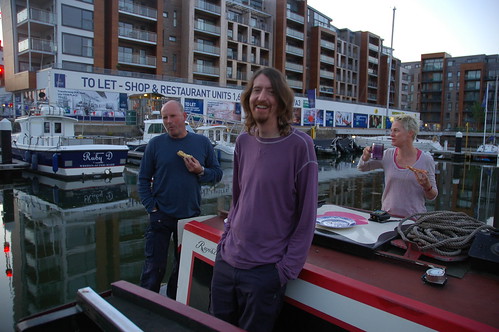 |
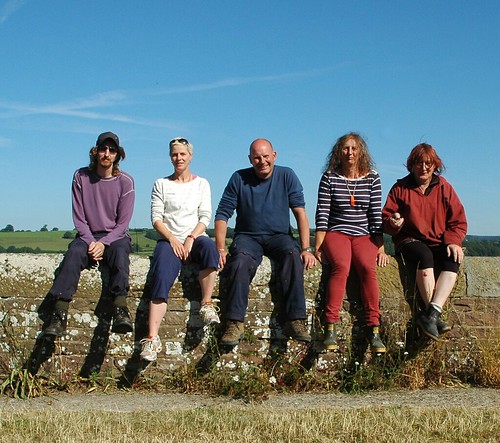
| Tony, Alan and Jo |

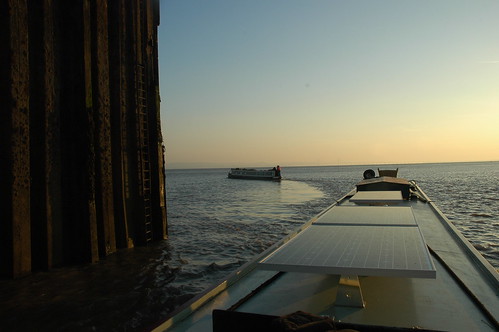
And so we set off. Three things were moving the boats; our engines, limited by Electra's top speed of about 5 knots; the incoming tide, whose speed varied with time and location; and the north-easterly breeze, which had by now freshened to a Force 2, as we passed the shelter of Portishead Pier and headed out into open water. We pointed our bows in the rough direction of Cardiff, and made a track towards the Shoots, that narrow and sometimes quite alarming channel between the English Stones and the Welsh Grounds, across which the Second Severn Crossing is built.
Not long ago, someone sailed from Portishead, heading for Sharpness, using a road map. He did not get very far. Though he didn't drown, and his boat was salvaged, he probably earned the title of 'duffer'. As you can see from the chart, the navigable channel meanders from bank to bank as you go upriver.

Passing under the first bridge, my Tom Tom told us that we were making 10 knots, though it was still unable to suggest a suitable route to Sharpness. This was unusual for my Tom Tom; I'd expected it at least to tell us to turn right as we passed under the motorway. I guess it was out of its depth.


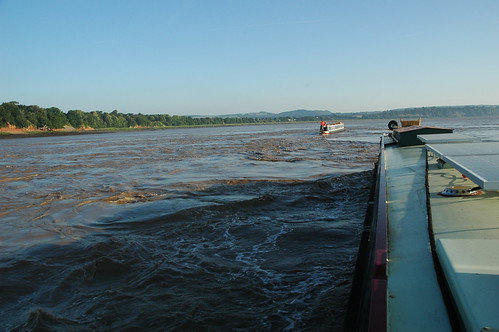
The surface of the river was as lively as several leprechauns, as the incoming tide rushed hither and thither; here a current pushing out from the reef of Charston Rock; there a whorl over Mathern Oaze as the water decided whether it was going to go up the Wye to Chepstow or on to Gloucester. Under the old Severn Bridge and past the Hen and Chickens, one last great whirlpool tugged playfully at the rudder as we passed Whirls End onto the Slime Road.
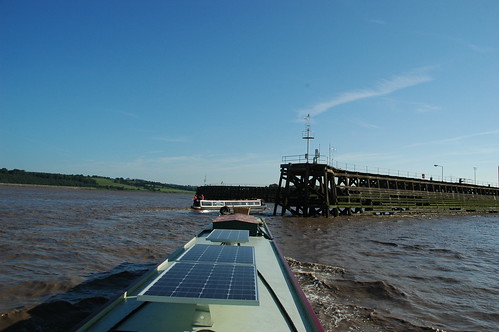
We passed the prominent towers of Oldbury nuclear power station, and made out the distant silos of Sharpness. For ages they seemed to remain resolutely in the far distance- then suddenly they resolved themselves, and the pier was looming over us.


Here is my account of the time that I canoed across the Severn Estuary, from New Passage to Chepstow, with Richard Beard
Tuesday, 2 July 2013
Brunel's Bristol
I've tried to include all of Brunel's works in the Bristol area, but there are still some missing... what you see, from the top down, are:

- SS Great Britain - launched 1843. Now on display in Patterson's dry dock in which it was built.
- SS Great Western -launched 1837. First steamship built for the Atlantic route, and largest passenger ship in the world at the time.
- Clifton Suspension Bridge- opened in 1864 after a long delay in building. Now holds record for the most-photographed bridge in the world. Or at least in Bristol.
- Temple Meads Station (the first one)
- a GWR locomotive (not designed by Brunel- apparently his engine designs were not that good, or so John Terry tells me... but it is here to represent the entire GWR line from London to Bristol, including Brunel's railway bridge over the Avon (not shown!)
- Paddle dredger 'Bertha' designed to act in conjunction with the underfall sluice (shown here in the foreground) to flush mud out of the harbour. A spade was dropped down, and dragged across the harbour by fixed chains, using the steam engine on board, putting the mud into the stream which would carry it away through the sluice.
- Swing bridge using a wrought iron tube as the stress member. This wasn't the first bridge design to use this feature: it was used at Chepstow for a railway bridge (no longer there) and the Albert Bridge, Saltash, over the Tamar.
- Floating caisson gate for the lock. The caisson (a watertight, air-filled structure) allowed the gate to float, reducing the weight on the hinges. This was the first use of them in this way.
- ...and Mr Brunel and his solicitor, Jeremiah Osborne, rowing along the Avon, surveying the route for the GWR track
Saturday, 29 June 2013
incident on the K&A, May 1941

The word was out, and Home Defence was going frantic:
“Bismarck must not break
through to the Atlantic.”
We stood to at dawn. Lock keepers were alerted.
Spotters’ cards were issued to all local Scouts and Guides;
“Vessel, grey and rather long, and - this can’t too often be
asserted-
If it’s marked ‘Kriegsmarine’, it’s probably the other
side’s.”
Around mid-morning, bicycle patrols at Avoncliff
Saw a periscope, or so at least they reckoned.
Workboat Saucy Winston
dropped a depth charge; then a second.
The two explosions echoed right round Sally in the Woods,
Startling the moorhens, setting rooks a-cawing; if
What Akela swore, that oil and wreckage had been seen, was
true,
The convoy at Brass
Knocker Basin,
with its vital goods
Intended for Devizes
Wharf, could now get
safely through.
On Caen Flight’s WRVS refreshment stall
The woman with the tea urn sternly turned away
A chap she thought a ‘foreign-sounding bugger’
Who asked if he could kindly have a coffee and a bun:
But when she found
out he was actually a Pole,
Who normally flew Spitfires but had just popped by
To meet a lady bargee he was sweet upon,
Apologised profusely, gave him extra sugar.
A flight of mallard came back in from Semington
With nothing to report. The afternoon grew older.
The hawthorn quietly blossomed in the sun.
Sedge warblers serenaded drowsy soldiers
In pillboxes new-built along the northern shore,
Who swore there’d never been so quiet a day before.
At six o’clock we put the kettle and the radio on,
And wondered if our dinner would be any good.
Big Ben tolled. “This is London. Earlier today, HMS Hood…”
This started when we were in Devizes recently, and we saw a poster about the Kennet and Avon canal during the war, which got us riffing about the action in The Cruel Sea and Sink The Bismarck! relocated to the canal...
Subscribe to:
Posts (Atom)