Showing posts with label Clifton Suspension Bridge. Show all posts

Wednesday, 28 August 2013

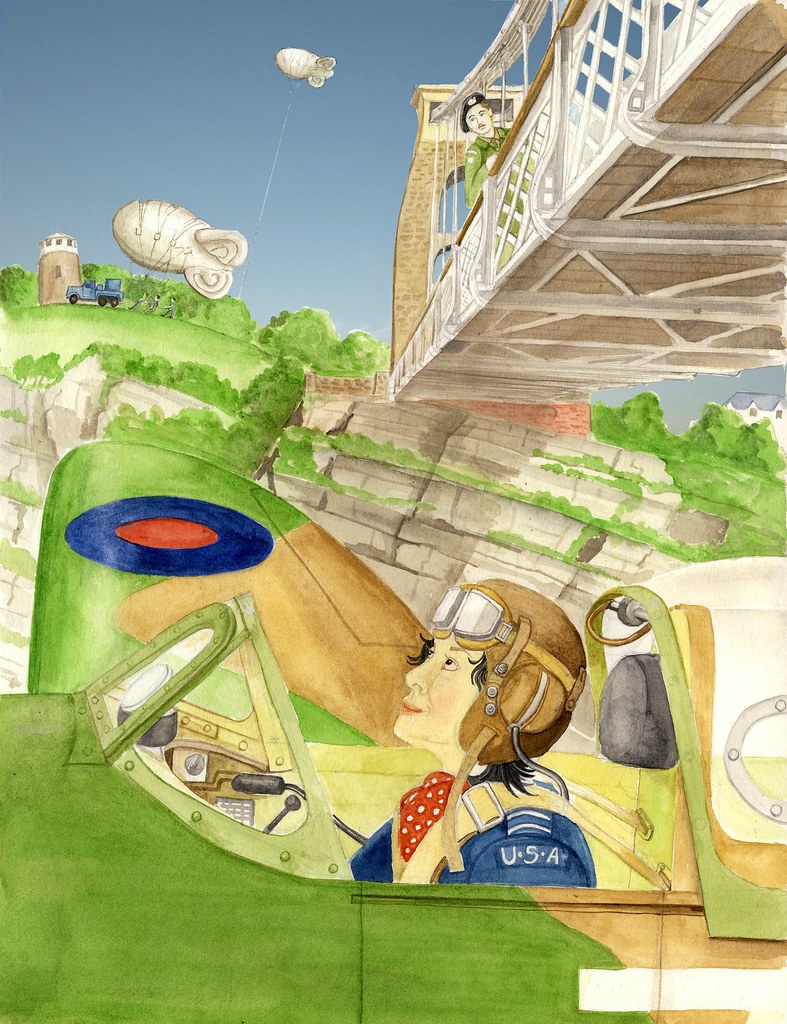
Ann Wood-Kelly flies under the Clifton suspension bridge


(available as a print)


Ann Wood-Kelly was an American pilot who came to Britain in 1942 and flew for the Air Transport Auxiliary, ferrying warplanes around Britain and, later in the war, Europe. Whitchurch Airport, in the suburbs of South Bristol, was an ATA base, as well as an important centre for civilian flights abroad; it was on a flight headed for Whitchurch from Lisbon that the Douglas DC-3 carrying Leslie Howard was shot down over the Bay of Biscay.

It was on delivery flights to Whitchurch that Ann Wood-Kelly twice flew under the Severn railway bridge at Sharpness, once in company with another pilot who led the way, and then next time alone; on the latter occasion, the tide was in, and there was 30ft less clearance than on the first time. Her obituary in the Guardian relocates these flights to the Clifton suspension bridge, which is presumably an error; but I thought it would make a good picture anyway, and who knows, maybe Ann did indeed fly under the Clifton suspension bridge- it would certainly have been less of a squeeze than the Severn railway bridge!

As for the poularity of flying under the Sharpness bridge, here is a description of it during the war from Brian Waters, in his book Severn Tide:


"The builder constructed this bridge so that river traffic could pass beneath it. What would he say if he could return to see airmen in their Spitfires and Hurricanes diving beneath his bridge like swallows on the wing? I admired their daring, until I saw the men whose job it is to paint the bridge, hanging in their cradle, while an aircraft dashed within a few feet of them"
The Clifton Suspension Bridge was also quite popular with pilots; I've found stories of Gloster Meteors and even a Canberra going under it; and Ken Griffiths, of Bristol's Fiducia Press, recalled watching a Vampire whizz by as he stood on Observatory Hill. This was not the most usually-recalled Vampire underflight, which ended in disaster....
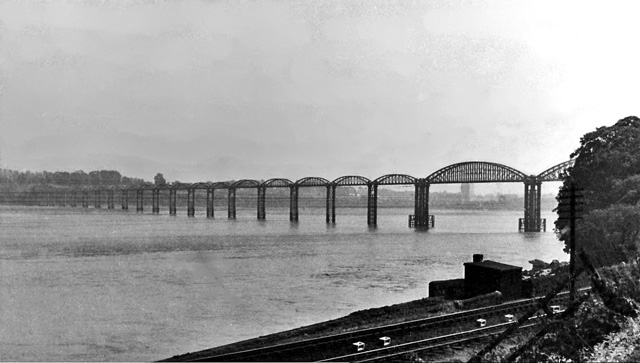

Severn railway bridge; photo by Ben Brooksbank (Creative Commons)

Tuesday, 2 July 2013

Brunel's Bristol


Brunel's Bristol, originally uploaded by Dru Marland.
I've tried to include all of Brunel's works in the Bristol area, but there are still some missing... what you see, from the top down, are:

  • SS Great Britain - launched 1843. Now on display in Patterson's dry dock in which it was built.
  • SS Great Western -launched 1837. First steamship built for the Atlantic route, and largest passenger ship in the world at the time.
  • Clifton Suspension Bridge- opened in 1864 after a long delay in building. Now holds record for the most-photographed bridge in the world. Or at least in Bristol.
  • Temple Meads Station (the first one)
  • a GWR locomotive (not designed by Brunel- apparently his engine designs were not that good, or so John Terry tells me... but it is here to represent the entire GWR line from London to Bristol, including Brunel's railway bridge over the Avon (not shown!)
  • Paddle dredger 'Bertha' designed to act in conjunction with the underfall sluice (shown here in the foreground) to flush mud out of the harbour. A spade was dropped down, and dragged across the harbour by fixed chains, using the steam engine on board, putting the mud into the stream which would carry it away through the sluice.
  • Swing bridge using a wrought iron tube as the stress member. This wasn't the first bridge design to use this feature: it was used at Chepstow for a railway bridge (no longer there) and the Albert Bridge, Saltash, over the Tamar.
  • Floating caisson gate for the lock. The caisson (a watertight, air-filled structure) allowed the gate to float, reducing the weight on the hinges. This was the first use of them in this way.
  • ...and Mr Brunel and his solicitor, Jeremiah Osborne, rowing along the Avon, surveying the route for the GWR track

Wednesday, 26 December 2012

vol de nuit


 Sometimes on a winter night here, you can see the wild geese flying high overhead, lit by the city lights. The first time I saw them, I was in the back garden drinking coffee before setting off on my motorbike to join a ship; I felt like a fellow traveller. Last winter I saw them when I was up on Observatory Hill admiring the snowy landscape.

Vol de Nuit is a book by Antoine de Saint-Exupery; checking up, it turns out it's not one I've read, and it ends badly. I used it as the title here because of that feeling you get when travelling at night, which reminds me of the mood of his books. And of course it sounds dead arty. Pretentious? Moi? Oui, cher lecteur.


...here's the soundtrack for a night journey- Jonathan Richman and the Modern Lovers: Roadrunner.


Saturday, 23 July 2011

the Canberra that went under the bridge

Continuing my series of true, gen-yoo-wine and authentic pictures of Aeroplanes That Flew Under The Clifton Suspension Bridge, here is a Canberra B2 jet bomber of 101 Squadron RAF, doing just that, on a summer's morning in 1951.


Come to think of it, in default of any further information on that flight, I reckon it's probably the 60th anniversary.


Shocking to think that it was so long ago... when I was very young, in Lancashire, I used to watch English Electric Lightnings flying around above where we lived, out on the flatlands of Longton Moss. They glinted silvery in the sun. They were test flying, from Samlesbury.

English Electric also built the Canberra. When we drove into Preston, we used to pass a long factory building that said English Electric on the wall, and I got excited at the thought of the jet aeroplanes they were building inside. It was not for some years that I discovered the company also built fridges....

..funny business, the companies that got involved with aircraft building. Like Boulton-Paul, who built the rather disastrous Defiant, and who are (or were) better known for building garden sheds....


some tags: flight, flying, flew, under, beneath, Bristol, Avon Gorge, aircraft, aeroplanes, RAF

Thursday, 7 July 2011

a low pass


a low pass, originally uploaded by Dru Marland.

This chap flew by, the other day, while we sat on the edge of the gorge. Very exciting it was too.

There's something about bridges that seems to attract aeroplanes. The best-known flight under the Clifton Suspension Bridge was one that ended in disaster; a Vampire jet fighter, that safely flew under the bridge but then appeared to attempt a roll and crashed into the cliff on the Leigh Woods side of the gorge.

Looking around over on PPRUNE, though, it seems that several other jets had previously flown under this bridge, too. Including a Gloster Meteor, a Canberra B2, and possibly a Hawker Hunter. One poster reckoned that it was quite a popular activity, and the pilots would fly low until well out over the Bristol Channel to remain invisible to radar, to avoid being identified and reprimanded....

the Hunter

the Canberra

Link