Saturday, 4 July 2009

foraging

I've been keeping an eye out for our local fox, the one that killed the magpie chick. I've not seen it for a couple of weeks now; maybe it succumbed to the mange.

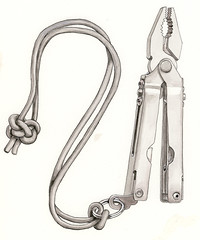
Something is still out there, though. Our untidy neighbours' rubbish bags, left stacked against their wheelie bin, were ripped open the other night, and a plastic meat tray had been carried out into the road and dumped there, looking peculiarly unsightly. I took out my terrifically handy Gerber Multi-Plier...and picked the tray up and dumped it in the bin, leaving a little pile of meat-soaked cigarette butts in the road. If even Mystery Animal had turned up its nose at these dubious snacks, I sure as heck wasn't taking any chances. I wiped the nose of the pliers in the hedge and returned them to my bag.

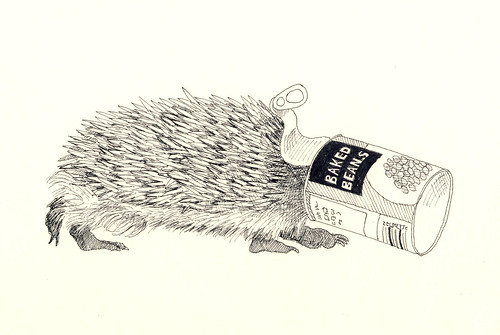
This morning, at about 3:30, I leaned out of the front window. The sky was deep blue with the first flush of dawn around the edges to the north and east, the air was perfectly still, and the city as silent as it ever gets; the earliest of early birds would not begin singing for another half hour or so. I saw a vaguely rugby-ball shaped thing ambling jauntily across the road. "Rat? -too plump. Vole? -too big. Ha! Hedgehog. I didn't realise they could move so fast." (I didn't actually say anything out loud, I'm not potty. I'm just dramatising my thoughts. Bear with me)

It's been a long time since I last saw a hedgehog wild and free. A very long time indeed, come to think of it. It was up on Mynydd Maen, back in the 70s, when I rescued one from the cattle grid next to my caravan, on two nights running, and fed it bread and milk. I guess the quality of the grub wasn't good enough, and it scarpered after that.

This morning's hedgehog squeezed through the wrought iron gate into next door's garden, and almost immediately there began a sort of sticky munching noise, with some crunching thrown in for good measure. I now know what it sounds like if you eat a snail with your mouth open. And without removing it from the shell first. I once sat opposite Richard while he snaffled a plate of frogs' legs. That was bad enough, even if it was in France. Come to that, I once sat, fastidiously playing with my food, while a Filipino sailor sitting opposite me noisily snaffled a bowl of fish heads. It was OK, in context. I would not like to dine out with this hedgehog, either within or beyond the bounds of the EU.

The munching ended suddenly, and the hedgehog reappeared, trundling across the road again to the next garden, where the noises started up again.

I left it to it.


Sunday, 28 June 2009

dancing and chapels


I've just finished reading Wendy Buonaventura's Midnight Rose, her account of the life of Maud Allen, an Edwardian era dancer famed (or notorious) for her depiction of Salome, and for the court case when she sued an MP for libel, after publication of an article called The Cult of the Clitoris, which suggested that she was a lesbian... Jolly good stuff, though now I must write a review of the book which goes a bit further than saying "jolly good stuff".

Meanwhile, over at Ian Marchant's blog, there's been talk of religion and of Welsh chapels, though not necessarily in the same breath.

And that reminded me of a poem by Idris Davies, and I just found my Big Book of Welsh Poems, so here it is.

Capel Calvin

There's holy holy people
They are in capel bach-
They don't like surpliced choirs,
They don't like Sospan Fach.

They don't like Sunday concerts,
Or women playing ball,
They don't like Williams Parry much
Or Shakespeare at all.

They don't like beer or bishops,
Or pictures without texts,
They don't like any other
Of the nonconformist sects.

And when they go to Heaven
They won't like that too well,
For the music will be sweeter
Than the music played in Hell.


Thursday, 25 June 2009

hearts and minds

a bicycle


a car

So I'm riding across the Downs on my way to the Clifton Suspension Bridge, to drop off some copies of The Bristol Downs- A Natural History Year (available in all good bookshops; if you go into a bookshop and you don't see this book, then you will know that it is a BAD bookshop, and you had better leave immediately) at the visitor centre.

And as I arrive at this junction, pretty much as you see it here...


View Larger Map

...the light turns from red to green so I continue straight ahead (for that is the route I am heading). The driver of a car behind me (rather close behind me, judging by the sound of the engine) hoots her horn. I look back and see that she is indicating her intention to turn left, and is expressing her annoyance that she can't simultaneously overtake me and turn left without damaging her car as she runs me over.

So I give her the finger.

As she turns, she calls out of her window in an aggrieved tone, "...and the same to you!"

A passing cyclist says, "It's OK, you were in the right"

I nod agreement.

But the woman in the car has evidently learned nothing from this encounter.

And what I have learned is that perhaps I should have stopped and explained to her that the purpose of her horn is to alert other road users to her presence, not to say "Get out of my way, cyclist!"

Hearts and minds, hearts and minds.


Wednesday, 24 June 2009

more on philosophy (Christina's response)


Christina Alley wrote a response to the previous post about my chat with Julian Baggini, but it was too long to go in the comments section. So here it is, as a post in its own right!

When I saw the link to your blog this morning, Dru, I became quite animated. I know Julian Baggini, vaguely, mostly through phone conversations when I was employed by an examination board to organise the setting and marking of examinations. We did not discuss any philosophy – our conversations usually related to Julian asking if I would be so kind as to send out a flier for his new magazine or book to the schools that taught A Level Philosophy. What I always found frustrating, as someone who had not studied Philosophy at university, was that the absolutely fascinating topics discussed at meetings of Philosophy examiners were mostly out of bounds for me. Oh, I would participate in the discussions about the questions on draft examination papers – but only in regard to the grammar, never the substance, of the questions. So, since the examination board no longer employs me, now is my chance to have a go at philosophy! Forgive me if I indulge myself :o)

Dru, I found this paragraph in your blog most stimulating… “Julian asked what I thought of Descartes' notion of the spirit as being entirely nonmaterial. I realised that I hadn't given the matter much thought. So I am doing now. My sense of self is strongly bound up with my physical body, as well as the mind that I was born with and which seems to have been delivered with a bunch of pre-installed software, such as (of course) gender identity, and a ragbag of qualities- innate abilities and weaknesses, the stuff we loosely describe as character or personality. My present self is the sum of all this and the experiences I've been through during my life, experiences that were mediated through the senses of my physical body.”

This set me thinking. Descartes doubted the reality of the material world and identified with his mind or soul rather than his body. Like a transsexual person, Descartes clearly felt a sense of alienation from his own body in that he saw it as a vehicle or machine which the mind, or soul, rides or inhabits. Perhaps the alienation which transsexual people feel towards their own bodies is just the natural alienation experienced by a thinking being…which we then interpret as alienation from the sex of our bodies [or perhaps Descartes was transsexual LOL]?

While Descartes (as far as I understand him), identified with his mind rather than his body, I (a transsexual person) identify with my mind more than my body – and I want to talk more about this. First, though, what does the existence of transsexual people say about human nature?

Thinking about the role of God, as Descartes would have done, one might conclude that the very existence of transsexual people says something about the perfection of ‘creation’ (presupposing the existence of God), or something about our ideas about the nature of God (e.g. God would only ever create perfect things), or something about society’s notions of ‘perfection’ (e.g. do we think that transsexual people are malfunctioning machines?), or something about the ‘sanctity’ of ‘male’ and ‘female’ as sexes and/or gender roles. Certainly, the existence of transsexual people poses problems to most people of a religious persuasion (including religious transsexual people) and the most common conundrum considered is who is in the wrong here – God, for creating an imperfect body, or the transsexual person for ‘going against nature’ or changing a perfect body – but this is premised on the assumptions that there is a God, that God would create everything to function perfectly and consistently, or that transsexual people are less perfect than the rest of creation. All of these assumptions are open to doubt.

I want to return to saying something about my thoughts about ‘mind’ and ‘soul’. Descartes appeared to use the words almost interchangeably and this has been a problem for later philosophers, I believe. The discipline of psychology looks at the functions and dysfunctions of the human brain. Insofar as the functions or dysfunctions of the brain can affect the ability of a person to think clearly and consistently, we can suppose that the brain and the mind are linked (the mind being the receptacle of our thoughts). Descartes suggested that the pineal gland is the structure in the brain that links the mind and the body (a claim he later dropped). If the soul is the mind and the mind is, in part, the brain, does this cause us another problem? In what form does the mind exist after the body and brain dies? Also, we know that our thoughts (and feelings) can become altered when illness or toxins affect our brain chemistry. Are all of our thoughts part of our mind/soul or only the ones that are labelled ‘sane’ or consistent with our usual patterns of thought or feelings? Which thoughts do we carry with us to the ‘after-life’ if there is one?

Turning to my own experiences, as a transsexual person who was brought up to be religious, I found it extremely difficult to reconcile my thoughts and feelings with the teachings of religion and with the prevalent attitudes of society at large. The ideas of a God and a soul is so ingrained in me that, despite a brief flirtation with atheism and humanism, I have sought to achieve a perspective on my existence which integrates the existence of a soul and a creator. Some religious groups say that one’s soul is gendered. If that is the case, then perhaps transsexual people’s souls are differently gendered to their bodies? One might say that this is making the mistake of taking an attribute of bodies (sex and/or gender) and mistakenly applying it to something that is non-material. However, insofar as the mind comprises one’s thoughts and the brain appears to make those thoughts possible, the mind would appear to be (at least in part) as material as the body. So, if the soul is non-material, it stands to reason that the soul is not the mind. So what on not-Earth is the soul then? Now I have a headache.

I still cling to the idea of a soul. For me, and I have no evidence for this, the soul is not gendered. Male and female are far to narrow and contingent categories to encompass fully something like a soul. I like to think that my soul, my ‘true’ nature, found ‘male’ ways of thinking and acting to be mismatched and too restrictive. ‘Female’ ways are far more in keeping with my ‘true nature’. But this says nothing about my sense of alienation from the physical form of my body, which is far more difficult to explain, and yet this is a common feeling amongst transsexual people – our bodies just feel wrong until we change them.

This brings me back to the ‘perfection of creation’. If God exists and God is perfect, does that not imply that God’s creation (the material world) is also perfect? Transsexual people, like those who have inherited diseases, mismatching eye colours, dyslexia, or any other condition that is a statistical outlier, would appear to be ‘imperfect’ if you take the view that what is most common (statistically) is most ‘perfect’. However, perhaps ‘God’s creation’ is perfect in a different way. Perhaps we are misunderstanding the purpose of this material existence (assuming there is a purpose). Perhaps God has created the world, body and life we each inhabit to teach us something. Perhaps this is all a process of ‘soul making’ and our soul is what we become after a lifetime, or lifetimes, of experience? In this view, the existence of transsexual people would be entirely consistent with the idea of God and a perfect creation. The question is, what is the ‘correct’ thing to do if you find yourself in a transsexual body?

Personally, I chose after many years of ‘soul-searching’ to change my body because that was the only way I could see to live my life fully and to the best of my ability. I would like to think that I have become a more ethical person since my transition. Certainly, I have been able to help more people through the voluntary work I now do. Why did I not do voluntary work before I transitioned? Well, I did, occasionally, but I was so hampered and exhausted by the continual internal struggle of being in the wrong body and wrong gender that it took something as dramatic as a ‘sex change’ to liberate me enough to start looking outwards at society and to see how I could contribute to making other people’s lives a little easier.

Tuesday, 23 June 2009

getting philosophical


Yesterday I met Julian Baggini, a philosopher who wanted me to talk about ideas of self and identity, because that's sort of what he does, and he was interested in the transsexual perspective on that. I tried to explain how it is for me, because that's sort of what I do.

I tried to explain my early sense of wrongness, and how I had felt that I ought to be gendered female, and how that seemed such a daft thing to want, not least because (for me, and in part) it involved modifying a reasonably healthy male body. And how I had thought that most people shared the same ambivalence (or antipathy) about their own sex, and it was just something that everyone lives with. It was a relatively recent discovery that most people are really very firm in their gender identity, and if they don't realise or notice this, it is because they are so immersed in it that they don't see it. As Susan Stryker said, "gender is the medium in which we swim".

I also described how there were two important aspects of my transition; the physical change on my body wrought by hormones and surgery, which has made me comfortable in my body - I feel now that I inhabit it, rather than feeling that I'd found myself in the house of a stranger; and the social element, whereby I both present myself as a woman and am treated as one. Both aspects are imperfectly attained; surgery and hormones do the best they can, though, given the material they had to start with; and if people identify me as having a transsexual history, then it can cause them to behave differently than they would otherwise. Still, we make the most of what we've got, don't we?

Julian asked what I thought of Descartes' notion of the spirit as being entirely nonmaterial. I realised that I hadn't given the matter much thought. So I am doing now. My sense of self is strongly bound up with my physical body, as well as the mind that I was born with and which seems to have been delivered with a bunch of pre-installed software, such as (of course) gender identity, and a ragbag of qualities- innate abilities and weaknesses, the stuff we loosely describe as character or personality. My present self is the sum of all this and the experiences I've been through during my life, experiences that were mediated through the senses of my physical body.

I got thinking about what it was like in Heaven, as imagined by me when I believed in Heaven. I had a vague notion of it being a bit like Wales in the 1960s, with my parents and family and friends there already, ready to resume things from where they left off when they died. This model worked for me when I was much younger, but it's hard to imagine it now. I'm too old, for one thing. I'm now seventeen years older than my mother was when she died, for instance. And there are people I'm not sure I'd want to meet in Heaven, even if they deserved a place there.

I asked Katie to imagine it. "What would we be like in Heaven?" I asked.

She pondered briefly.

"We'd be like ourselves," she said; "at our best".

Which is a good answer.

I am open to the idea of there being a spirit world, having had a few experiences of that sort along the way, but I've really no idea what goes on there. Maybe I'll find out one day, and maybe I won't. Trying to visualise it seems a bit of a waste of effort, not least because it can end up seeming a bit silly. I remember Milton, describing the war in Heaven in Paradise Lost, where the angelic armies are marching around in the sky decked out in Civil War period arms and armour. This seems a bit Disney, really. I saw that bloody awful film of Pearl Harbour, where they threw every bit of CGI they could at the story and it ended up much too long and much too absurd. I hope Heaven isn't like that. And then there's Raphael, coyly describing sex among the angels in Book 8:


Let it suffice thee that thou know'st [ 620 ]
Us happie, and without Love no happiness.
Whatever pure thou in the body enjoy'st
(And pure thou wert created) we enjoy
In eminence, and obstacle find none
Of membrane, joynt, or limb, exclusive barrs: [ 625 ]
Easier then Air with Air, if Spirits embrace,
Total they mix, Union of Pure with Pure
Desiring; nor restrain'd conveyance need
As Flesh to mix with Flesh, or Soul with Soul.
...which Pope in turn spoofs in Rape of the Lock, here:
....spirits, freed from mortal laws, with ease
Assume what sexes and what shapes they please
...which sounds a bit like Second Life, if you ask me. Crikey, would I want to spend an eternity in Second Life? -I don't think I even want to spend five minutes there, though at least I've still got my First Life to play with. For a while longer, at least.

Monday, 22 June 2009

Bristol's Biggest Bike Ride


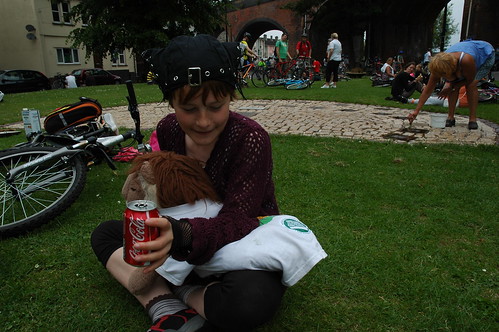
Sunday was Bristol's Biggest Bike Ride, and it's become something of a tradition for Katie and me; we've been doing it ever since she was riding behind me on a trailer bike. So we joined in yet again, riding the Avon Loop, which goes down the Portway, the main road down the Avon Gorge, closed to other traffic for the day so that it is unusually peaceful- just the ticking of bicycle gears and the occasional tinkling of bells; then over the Avonmouth motorway bridge, and back up the cycle path along the bank of the Avon, and so to the city centre again.


As you can see from this picture of a bottleneck at Pill, a small port on the Somerset bank, there were thousands of people. There was also a pub open next to this patch of green, and our friends Mal and Adrian. So we stopped for lunch. The Sally Army came along and started playing, so Mal and I joined in with the singing. I was fortunate, though I didn't think so at the time, in that my school had dumped their old A&M style hymn book and replaced them with a 'happy clappy' one in 1971; we were very 'with it' in the Valleys; and so I knew the words to Give me joy in my heart, make me happy, though in my head I still hear it in a Valleys accent.... sing 'osannah, sing 'osannah, sing 'osannah to the king of kings....

Katie looked as though she wished that the ground would swallow her up...


Well, it was good being part of a little 'world turned upside down' event, especially seeing an apoplectic motorist in a Big Car trying to force his way against the flow of thousands of bicycles, presumably to prove a point, while shaking his head in theatrical disbelief- "I'm a motorist, so I take precedence". Duh. But I'm not entirely sure that cycling is as morally-improving as I might have hoped; there was some quite selfish riding (stupid overtaking and cutting-in) going on. It wasn't supposed to be a race, dumbfucks.

Home again, achy and tired. I think it was the constant stopping and starting and dodging other people that was the tiring part. We don't usually do group things. Not sure I want to again. I'm pining for the mountains...

Sunday, 21 June 2009

one midsummer morning


Out and about bright and early, to see how the summer is getting along. The wild cherries are getting perfectly ripe now, and, unusually, there were lots of deep red ones hanging there for the picking when Katie and I went out the evening before; usually the birds get there first. As we were happily picking and eating, a man walked by with his dog. He looked quizzically at us.

"Wild cherries," I explained, and presented him with one.

He stared mistrustfully at it and slowly handed it back.

On this early morning sortie, though, the tree was busy with blackbirds, all tucking in.


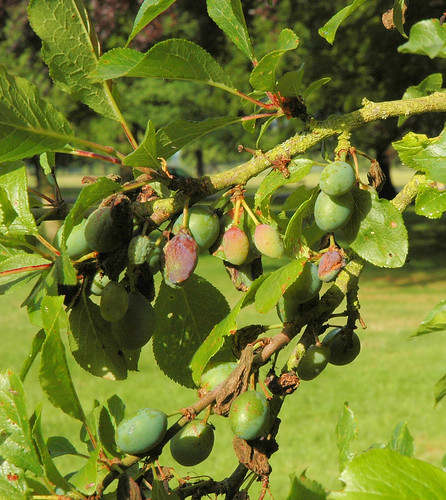
Here are the damsons, some of which I shall be steeping in vodka later in the season. Last year's damson vodka was really extremely good...


...and so down to the side of the gorge. I passed the avenue of trees which stretches from Sneyd Park (Bristol's poshest suburb) to Ladies Mile, and along which the Sneyd Park dog walkers promenade. Several dogs hurtled towards each other and started fighting.

"Heah! I said HEAH!!" called a woman in a voice accustomed to command, if not to be obeyed.

(This reminded me of the occasion when I was walking in these parts with my lurcher, long ago. A Range Rover stopped not far off; the driver, accoutred in flat cap, corduroy trousers, Barbour Jacket and Hunter wellies, opened the back door and a couple of labradors came bounding across to say hello, ignoring his fruity and progressively louder admonishment: "Purdey! PURRRDEH!!" (Purdey, if you didn't know, is a posh make of shotgun, and of course the name of the character played by Joanna Lumley in The New Avengers...))

...through the wildlife meadow, with the sound of squabbling dogs and foghorning Sneyd Park matrons receding astern. And I hear a chiffchaff singing, though it is fighting for airspace with the massively amplified music drifting across the gorge from Leigh Woods, where an illicit all-night party is still under way.

At Peregrine Point I meet Mandy Leivers, the Education Officer from Bristol Zoo, setting out leaflets in readiness for a family walk around the Downs.

A heron flies over, high up.

I head for the cafe.

Happy solstice!