Wednesday, 24 June 2009

more on philosophy (Christina's response)


Christina Alley wrote a response to the previous post about my chat with Julian Baggini, but it was too long to go in the comments section. So here it is, as a post in its own right!

When I saw the link to your blog this morning, Dru, I became quite animated. I know Julian Baggini, vaguely, mostly through phone conversations when I was employed by an examination board to organise the setting and marking of examinations. We did not discuss any philosophy – our conversations usually related to Julian asking if I would be so kind as to send out a flier for his new magazine or book to the schools that taught A Level Philosophy. What I always found frustrating, as someone who had not studied Philosophy at university, was that the absolutely fascinating topics discussed at meetings of Philosophy examiners were mostly out of bounds for me. Oh, I would participate in the discussions about the questions on draft examination papers – but only in regard to the grammar, never the substance, of the questions. So, since the examination board no longer employs me, now is my chance to have a go at philosophy! Forgive me if I indulge myself :o)

Dru, I found this paragraph in your blog most stimulating… “Julian asked what I thought of Descartes' notion of the spirit as being entirely nonmaterial. I realised that I hadn't given the matter much thought. So I am doing now. My sense of self is strongly bound up with my physical body, as well as the mind that I was born with and which seems to have been delivered with a bunch of pre-installed software, such as (of course) gender identity, and a ragbag of qualities- innate abilities and weaknesses, the stuff we loosely describe as character or personality. My present self is the sum of all this and the experiences I've been through during my life, experiences that were mediated through the senses of my physical body.”

This set me thinking. Descartes doubted the reality of the material world and identified with his mind or soul rather than his body. Like a transsexual person, Descartes clearly felt a sense of alienation from his own body in that he saw it as a vehicle or machine which the mind, or soul, rides or inhabits. Perhaps the alienation which transsexual people feel towards their own bodies is just the natural alienation experienced by a thinking being…which we then interpret as alienation from the sex of our bodies [or perhaps Descartes was transsexual LOL]?

While Descartes (as far as I understand him), identified with his mind rather than his body, I (a transsexual person) identify with my mind more than my body – and I want to talk more about this. First, though, what does the existence of transsexual people say about human nature?

Thinking about the role of God, as Descartes would have done, one might conclude that the very existence of transsexual people says something about the perfection of ‘creation’ (presupposing the existence of God), or something about our ideas about the nature of God (e.g. God would only ever create perfect things), or something about society’s notions of ‘perfection’ (e.g. do we think that transsexual people are malfunctioning machines?), or something about the ‘sanctity’ of ‘male’ and ‘female’ as sexes and/or gender roles. Certainly, the existence of transsexual people poses problems to most people of a religious persuasion (including religious transsexual people) and the most common conundrum considered is who is in the wrong here – God, for creating an imperfect body, or the transsexual person for ‘going against nature’ or changing a perfect body – but this is premised on the assumptions that there is a God, that God would create everything to function perfectly and consistently, or that transsexual people are less perfect than the rest of creation. All of these assumptions are open to doubt.

I want to return to saying something about my thoughts about ‘mind’ and ‘soul’. Descartes appeared to use the words almost interchangeably and this has been a problem for later philosophers, I believe. The discipline of psychology looks at the functions and dysfunctions of the human brain. Insofar as the functions or dysfunctions of the brain can affect the ability of a person to think clearly and consistently, we can suppose that the brain and the mind are linked (the mind being the receptacle of our thoughts). Descartes suggested that the pineal gland is the structure in the brain that links the mind and the body (a claim he later dropped). If the soul is the mind and the mind is, in part, the brain, does this cause us another problem? In what form does the mind exist after the body and brain dies? Also, we know that our thoughts (and feelings) can become altered when illness or toxins affect our brain chemistry. Are all of our thoughts part of our mind/soul or only the ones that are labelled ‘sane’ or consistent with our usual patterns of thought or feelings? Which thoughts do we carry with us to the ‘after-life’ if there is one?

Turning to my own experiences, as a transsexual person who was brought up to be religious, I found it extremely difficult to reconcile my thoughts and feelings with the teachings of religion and with the prevalent attitudes of society at large. The ideas of a God and a soul is so ingrained in me that, despite a brief flirtation with atheism and humanism, I have sought to achieve a perspective on my existence which integrates the existence of a soul and a creator. Some religious groups say that one’s soul is gendered. If that is the case, then perhaps transsexual people’s souls are differently gendered to their bodies? One might say that this is making the mistake of taking an attribute of bodies (sex and/or gender) and mistakenly applying it to something that is non-material. However, insofar as the mind comprises one’s thoughts and the brain appears to make those thoughts possible, the mind would appear to be (at least in part) as material as the body. So, if the soul is non-material, it stands to reason that the soul is not the mind. So what on not-Earth is the soul then? Now I have a headache.

I still cling to the idea of a soul. For me, and I have no evidence for this, the soul is not gendered. Male and female are far to narrow and contingent categories to encompass fully something like a soul. I like to think that my soul, my ‘true’ nature, found ‘male’ ways of thinking and acting to be mismatched and too restrictive. ‘Female’ ways are far more in keeping with my ‘true nature’. But this says nothing about my sense of alienation from the physical form of my body, which is far more difficult to explain, and yet this is a common feeling amongst transsexual people – our bodies just feel wrong until we change them.

This brings me back to the ‘perfection of creation’. If God exists and God is perfect, does that not imply that God’s creation (the material world) is also perfect? Transsexual people, like those who have inherited diseases, mismatching eye colours, dyslexia, or any other condition that is a statistical outlier, would appear to be ‘imperfect’ if you take the view that what is most common (statistically) is most ‘perfect’. However, perhaps ‘God’s creation’ is perfect in a different way. Perhaps we are misunderstanding the purpose of this material existence (assuming there is a purpose). Perhaps God has created the world, body and life we each inhabit to teach us something. Perhaps this is all a process of ‘soul making’ and our soul is what we become after a lifetime, or lifetimes, of experience? In this view, the existence of transsexual people would be entirely consistent with the idea of God and a perfect creation. The question is, what is the ‘correct’ thing to do if you find yourself in a transsexual body?

Personally, I chose after many years of ‘soul-searching’ to change my body because that was the only way I could see to live my life fully and to the best of my ability. I would like to think that I have become a more ethical person since my transition. Certainly, I have been able to help more people through the voluntary work I now do. Why did I not do voluntary work before I transitioned? Well, I did, occasionally, but I was so hampered and exhausted by the continual internal struggle of being in the wrong body and wrong gender that it took something as dramatic as a ‘sex change’ to liberate me enough to start looking outwards at society and to see how I could contribute to making other people’s lives a little easier.

Tuesday, 23 June 2009

getting philosophical


Yesterday I met Julian Baggini, a philosopher who wanted me to talk about ideas of self and identity, because that's sort of what he does, and he was interested in the transsexual perspective on that. I tried to explain how it is for me, because that's sort of what I do.

I tried to explain my early sense of wrongness, and how I had felt that I ought to be gendered female, and how that seemed such a daft thing to want, not least because (for me, and in part) it involved modifying a reasonably healthy male body. And how I had thought that most people shared the same ambivalence (or antipathy) about their own sex, and it was just something that everyone lives with. It was a relatively recent discovery that most people are really very firm in their gender identity, and if they don't realise or notice this, it is because they are so immersed in it that they don't see it. As Susan Stryker said, "gender is the medium in which we swim".

I also described how there were two important aspects of my transition; the physical change on my body wrought by hormones and surgery, which has made me comfortable in my body - I feel now that I inhabit it, rather than feeling that I'd found myself in the house of a stranger; and the social element, whereby I both present myself as a woman and am treated as one. Both aspects are imperfectly attained; surgery and hormones do the best they can, though, given the material they had to start with; and if people identify me as having a transsexual history, then it can cause them to behave differently than they would otherwise. Still, we make the most of what we've got, don't we?

Julian asked what I thought of Descartes' notion of the spirit as being entirely nonmaterial. I realised that I hadn't given the matter much thought. So I am doing now. My sense of self is strongly bound up with my physical body, as well as the mind that I was born with and which seems to have been delivered with a bunch of pre-installed software, such as (of course) gender identity, and a ragbag of qualities- innate abilities and weaknesses, the stuff we loosely describe as character or personality. My present self is the sum of all this and the experiences I've been through during my life, experiences that were mediated through the senses of my physical body.

I got thinking about what it was like in Heaven, as imagined by me when I believed in Heaven. I had a vague notion of it being a bit like Wales in the 1960s, with my parents and family and friends there already, ready to resume things from where they left off when they died. This model worked for me when I was much younger, but it's hard to imagine it now. I'm too old, for one thing. I'm now seventeen years older than my mother was when she died, for instance. And there are people I'm not sure I'd want to meet in Heaven, even if they deserved a place there.

I asked Katie to imagine it. "What would we be like in Heaven?" I asked.

She pondered briefly.

"We'd be like ourselves," she said; "at our best".

Which is a good answer.

I am open to the idea of there being a spirit world, having had a few experiences of that sort along the way, but I've really no idea what goes on there. Maybe I'll find out one day, and maybe I won't. Trying to visualise it seems a bit of a waste of effort, not least because it can end up seeming a bit silly. I remember Milton, describing the war in Heaven in Paradise Lost, where the angelic armies are marching around in the sky decked out in Civil War period arms and armour. This seems a bit Disney, really. I saw that bloody awful film of Pearl Harbour, where they threw every bit of CGI they could at the story and it ended up much too long and much too absurd. I hope Heaven isn't like that. And then there's Raphael, coyly describing sex among the angels in Book 8:


Let it suffice thee that thou know'st [ 620 ]
Us happie, and without Love no happiness.
Whatever pure thou in the body enjoy'st
(And pure thou wert created) we enjoy
In eminence, and obstacle find none
Of membrane, joynt, or limb, exclusive barrs: [ 625 ]
Easier then Air with Air, if Spirits embrace,
Total they mix, Union of Pure with Pure
Desiring; nor restrain'd conveyance need
As Flesh to mix with Flesh, or Soul with Soul.
...which Pope in turn spoofs in Rape of the Lock, here:
....spirits, freed from mortal laws, with ease
Assume what sexes and what shapes they please
...which sounds a bit like Second Life, if you ask me. Crikey, would I want to spend an eternity in Second Life? -I don't think I even want to spend five minutes there, though at least I've still got my First Life to play with. For a while longer, at least.

Monday, 22 June 2009

Bristol's Biggest Bike Ride


Sunday was Bristol's Biggest Bike Ride, and it's become something of a tradition for Katie and me; we've been doing it ever since she was riding behind me on a trailer bike. So we joined in yet again, riding the Avon Loop, which goes down the Portway, the main road down the Avon Gorge, closed to other traffic for the day so that it is unusually peaceful- just the ticking of bicycle gears and the occasional tinkling of bells; then over the Avonmouth motorway bridge, and back up the cycle path along the bank of the Avon, and so to the city centre again.


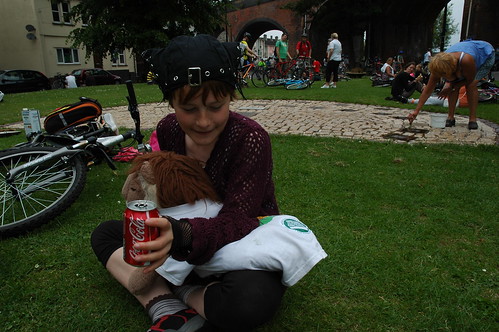
As you can see from this picture of a bottleneck at Pill, a small port on the Somerset bank, there were thousands of people. There was also a pub open next to this patch of green, and our friends Mal and Adrian. So we stopped for lunch. The Sally Army came along and started playing, so Mal and I joined in with the singing. I was fortunate, though I didn't think so at the time, in that my school had dumped their old A&M style hymn book and replaced them with a 'happy clappy' one in 1971; we were very 'with it' in the Valleys; and so I knew the words to Give me joy in my heart, make me happy, though in my head I still hear it in a Valleys accent.... sing 'osannah, sing 'osannah, sing 'osannah to the king of kings....

Katie looked as though she wished that the ground would swallow her up...


Well, it was good being part of a little 'world turned upside down' event, especially seeing an apoplectic motorist in a Big Car trying to force his way against the flow of thousands of bicycles, presumably to prove a point, while shaking his head in theatrical disbelief- "I'm a motorist, so I take precedence". Duh. But I'm not entirely sure that cycling is as morally-improving as I might have hoped; there was some quite selfish riding (stupid overtaking and cutting-in) going on. It wasn't supposed to be a race, dumbfucks.

Home again, achy and tired. I think it was the constant stopping and starting and dodging other people that was the tiring part. We don't usually do group things. Not sure I want to again. I'm pining for the mountains...

Sunday, 21 June 2009

one midsummer morning


Out and about bright and early, to see how the summer is getting along. The wild cherries are getting perfectly ripe now, and, unusually, there were lots of deep red ones hanging there for the picking when Katie and I went out the evening before; usually the birds get there first. As we were happily picking and eating, a man walked by with his dog. He looked quizzically at us.

"Wild cherries," I explained, and presented him with one.

He stared mistrustfully at it and slowly handed it back.

On this early morning sortie, though, the tree was busy with blackbirds, all tucking in.


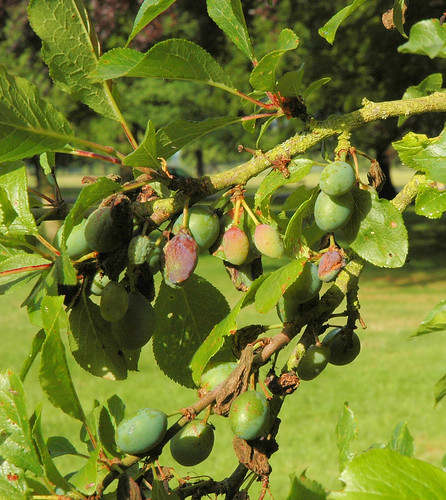
Here are the damsons, some of which I shall be steeping in vodka later in the season. Last year's damson vodka was really extremely good...


...and so down to the side of the gorge. I passed the avenue of trees which stretches from Sneyd Park (Bristol's poshest suburb) to Ladies Mile, and along which the Sneyd Park dog walkers promenade. Several dogs hurtled towards each other and started fighting.

"Heah! I said HEAH!!" called a woman in a voice accustomed to command, if not to be obeyed.

(This reminded me of the occasion when I was walking in these parts with my lurcher, long ago. A Range Rover stopped not far off; the driver, accoutred in flat cap, corduroy trousers, Barbour Jacket and Hunter wellies, opened the back door and a couple of labradors came bounding across to say hello, ignoring his fruity and progressively louder admonishment: "Purdey! PURRRDEH!!" (Purdey, if you didn't know, is a posh make of shotgun, and of course the name of the character played by Joanna Lumley in The New Avengers...))

...through the wildlife meadow, with the sound of squabbling dogs and foghorning Sneyd Park matrons receding astern. And I hear a chiffchaff singing, though it is fighting for airspace with the massively amplified music drifting across the gorge from Leigh Woods, where an illicit all-night party is still under way.

At Peregrine Point I meet Mandy Leivers, the Education Officer from Bristol Zoo, setting out leaflets in readiness for a family walk around the Downs.

A heron flies over, high up.

I head for the cafe.

Happy solstice!

Friday, 19 June 2009

wild things

I get up early and gaze out of the front window to see what's going on in the world. I'd usually expect to see our local fox doing its rounds, but I've not seen it for a week or so now. Perhaps the mange has got it. Or any of the other unpleasant things that can happen to foxes, thus ensuring that their lives are possibly nasty and brutish, but almost always short.

Yuki and Pookie were peering intently at me, so I took a picture of them. Note: A canary in a cage puts all heaven in a rage. But rats are OK.

There's been lots of moths flitting around the flat lately. Small dusty grey looking things, I captured one in a jam jar last night and had as good a look as possible, and concluded that my fears had been realised and it is a clothes moth. So I squirted fly spray into the jar and quickly put the lid on. A nasty way to murder a moth; it is somehow better to splat them with a rolled-up newspaper. I'd been hoping to pin it out after it had died, to get a good picture of it with my camera. But it got mired in a little puddle of fly spray and by the time I'd got it onto a piece of paper it was in a sorry old state.


Katie's first thought was for her stuffed toys, particularly Llygoden, whose (possibly organic Welsh) woollen complexion would be a tasty treat for any passing moth. So she put them in a bag with a gallon of lavender oil, to keep them safe. "A few drops would do", I said, but it was too late by then.

The stuffed toys at least will sleep soundly.

I must find a friendly garden where I can pick some herbs for strewing.

Thursday, 18 June 2009

Irish Independent

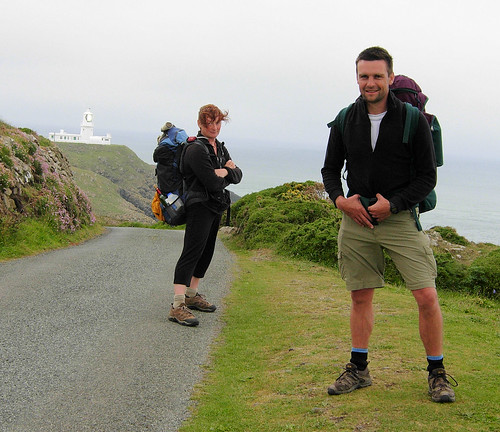
There was a nice write-up in the Irish Independent, following the Dublin reading that Richard and I did. Without Richard, of course. Because of the chicken pox. But Andrea Smith pieced out our imperfections with her thoughts. And they used my fave 'group' photo from the walk, at Strumble Head in Pembs. And I've got killer cheekbones. It was worth it for that alone! Thanks, Andrea!

Following a friend on the difficult road across gender

Richard Beard had a long way to go when he first saw the man with a pearl earring, writes Andrea Smith

Sunday June 14 2009

Drusilla Marland was born the second of four brothers.

She is on good terms with both of her ex-wives.

She was thrilled to become a dad.

Thus author Richard Beard describes the breakdown of grammatical orthodoxy that is an occasional side effect of describing the circumstances of his close friend, Drusilla Philippa Marland, known as Dru.

When Richard first got to know Dru, she was then called Drew -- a motorcycling male engineer in his 30s with whom he went on camping and walking holidays. These trips were a back-to-nature quest for Richard, reminding him of what it meant to be truly alive and what it meant to be a man.

Then, after 10 years of thinking he knew everything about the friend he shared a two-person tent with, came the call that threw him into confusion. The following day, Richard went to Dru's flat in Bristol, and tried not to react when he saw his friend in pearl earrings. He noted the shaved forearms too, as he listened to his friend's request to think of him as a woman from then on.

By his own admission, Richard didn't cover himself in glory with his initial reaction, as he describes the thoughts that initially ran through his mind.

"You are a 43-year-old man whose wife has just left you for another bloke, taking your daughter with her. You have a dismantled crankshaft on the table in your front room. You drink lunchtime pints of Smiles Old Tosser and you work in the engine room of a 7,000-ton passenger ship. You are not a woman."

After this, Richard went home, read books on the subject and did his best to understand what had just been presented to him. Still seeking answers, he suggested writing Dru's story, and by his own admission, he was partly trying to catch his friend out.

"If Drusilla is not true, then in her place sits a fizzing combination of modern afflictions," he says in the book. "She's probably psychotic, possibly sexually deviant, certainly attention-seeking, and conceivably a secret special agent of the patriarchy. No wonder candidates for surgery have to see so many psychiatrists."

In person, Dru is a softly spoken woman with killer cheekbones and eccentric dress sense. At her book reading in the Winding Stair bookshop, she is by turns coquettish, amusing, gentle and hesitant. Telling the story of her difficult and often painful journey to womanhood requires bravery, not least because she has not been universally accepted.

Indeed, she was awarded £64,862 (€76,276) compensation in 2006, after a tribunal found she was forced to endure "an atmosphere of intimidation and hostility" while she was undergoing gender reassignment while working for P&O Ferries.

The Southampton tribunal found that she was constructively dismissed through having to endure "constant gender-based ribaldry" relating to the gender reassignment, and offensive remarks from other staff members.

It is no wonder, then, that her intelligent eyes glisten with sensitivity, framed by "spinster" glasses.

As the passages describing Richard's experience are read, it becomes clear that the author has also gone on his own complicated journey to acceptance and understanding of Drusilla's situation.

"I want to say I'm sorry," he says. "It must be horrible and tiresome having people look all the time, having me look all the time. Christ, I wouldn't like it, to be looked over so closely by someone like me."

Becoming Drusilla is a remarkable story of friendship, courage and humanity. Achingly funny, bruisingly heart-rending and deeply honest and personal, the story is gracefully and humbly told and free of mawkish sentimentality.

Both Richard and Dru struggle with the new and fragile world they find themselves in. The journey is traced from Dru's early days, through realising that she was born in the wrong body and her subsequent journey to full womanhood.

They still go camping together, notwithstanding prejudice from equipment store owners who insist on calling Dru, "Sir." And Richard worries about what the future will hold for his friend Dru, who is in an intensely complicated and vulnerable position, due to spending the first 43 years of her life as a man.

"I do sometimes worry that Dru will lose her way," he says. "I mean really lose her way. That she'll drop into a life of special-interest groups and Oxfam scavenging, and the occasional indignant letter to the Daily Mail. Or end up a bag lady on a permanent shuttle between ... the Gloucester Road charity shops, too old to jump into skips, her day made or broken by whether there's bottled beer in the house come five past six."

Then again, he concludes, he worries about everyone he loves, and in brighter moments, he sees Dru as an eccentric lady driving around Bristol in her Morris Minor, getting mistaken by people of a certain age for the district nurse.

"The lucky children in her street will know her as the mystery woman with many bangles who will mend a puncture before Mum comes home," he says. "And solve any problems with a bully."

Becoming Drusilla: One Life, Two Friends, Three Genders by Richard Beard (Vintage UK, Random House, €10.40)

- Andrea Smith


Wednesday, 17 June 2009

my pink half of the drainpipe

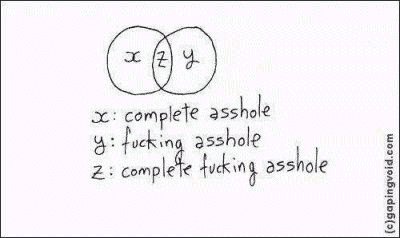
thank you, Gaping Void!

Nothing can my peace disturb. Well, apart from the chavs down the road who wake up at about eleven in the morning and put crap music on too loud. Which is probably no more noisy than the sit-upon lawnmower that the aspirational neighbours fire up to mow their five square yards of tired urban grass. But is certainly more annoying.

Some people try, though. I found a hand-delivered letter on the mat yesterday, from someone at the City Council. As it had been correctly addressed to me, I inferred that one of my neighbours had complained about me to the Council.

I note that your boat/trailer has been placed on the carriageway of the public highway at the above-mentioned location for some weeeks. The boat/trailer displays no reflectors or license plate and faces the wrong direction to traffic, therefore I must instruct you to remove the boat/trailer and not replace it on the highway in future. Sections 143/149 of the Highways Act 1980 empower the Council to remove from the highway any structures/items causing danger/obstruction and recover the expenses of so doing from the person having control or possession of the structure/item.

So I turned the boat around and put a towing board on it with a number plate and reflectors. And I called up the chap who signed the letter and explained that the boat is only going to be here until I've finished repairing it; and that there is never any shortage of parking in my road anyway. He was fine about it, and commented that he at least had nice neighbours. "So do I," I said, "...mostly".


I didn't bother adding that there'd be even more parking if people weren't so fiercely protective of the space in front of their houses, especially those people who jealously assert the presumed privileges of dropped kerbs, which, even long after their original purpose (access to basement garages long converted into flats) has ceased to be, demand the right to park their cars across this space on the road....

Suburban pettinesses.

Here are some choice examples of local parking from my collection, by the way. They aren't parked in these odd places because there are no better places available; they are parked like this because their owners don't want to walk more than a few paces to their front doors.


One of them recently had a polite notice from the police stuck under its windscreen wiper, suggesting that they may have action taken against them. A week later the car and the notice were still there. Then one day the car was gone and the notice was in the gutter. Hopefully the owner had read the notice before discarding it, and taken note that 'antisocial' parking is actually acceptable behaviour.