Showing posts with label feminism. Show all posts

Monday, 30 April 2012

SPUC off


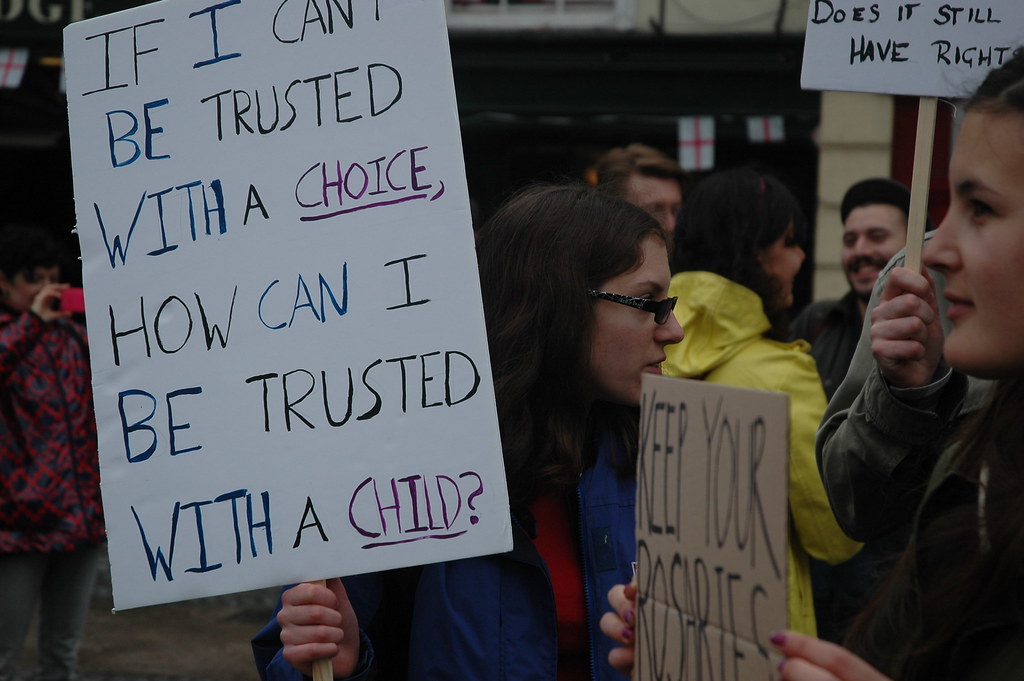
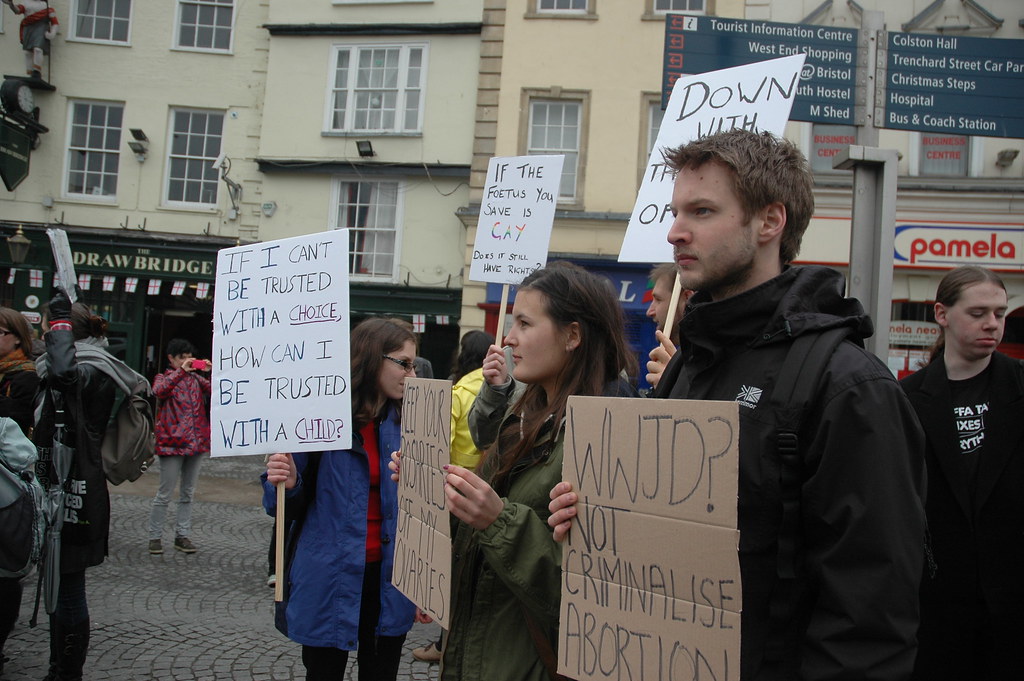
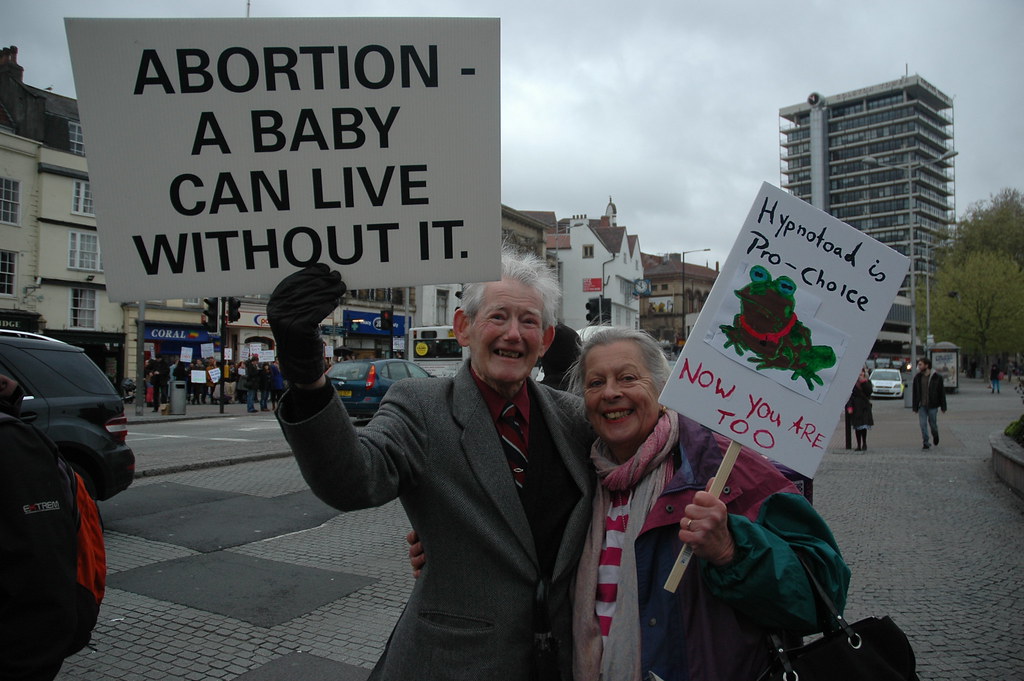
There were SPUC anti-choice demonstrations around the country on Saturday. One of them was in Bristol, and so there was a bit of a counter-demo by pro-choicers from various groups; Bristol Feminist Network was strongly represented, and I noticed several anarchist flags. And just individuals who disagreed with This Sort Of Thing, and wanted to stand up and be counted. I was among the latter.

Bimbling over to St Augustine's Parade with Mal at 10.45, all was quiet except for an elderly bearded chap with a big bag of placards. "Are you here for the demo?" Mal asked. 
"Yes," he said. "Are you?"
"Oh, yes," said Mal.
"Which side- pro, or anti?"
"Oh, definitely," she said. And we wandered around a bit more.
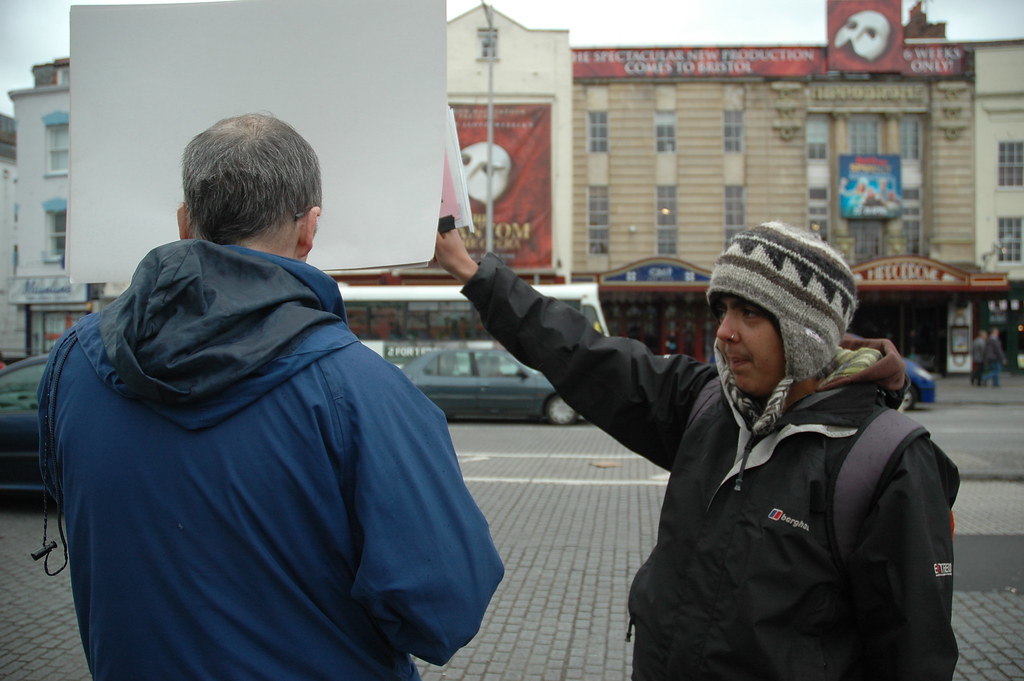
Presently more people appeared; some more chaps with beards displayed their identical anti-choice banners, and an ever-swelling group on the other side of the road with a variety of placards. We joined them.


Presently, some of the pro-choice people went and mingled with the opposition.


Some attempted to engage with them, though not always successfully

Mal got talking with J, whose birthday it was. He told her why he was there among the anti-choice group. Just after the war, his mother was coerced into an abortion by her husband, who thought that they couldn't afford another child. So she went into hospital and went through the procedure, and then the medics pickled the foetus in preserving fluid and presented it to her, presumably to say "look, this is your fault!"
This was the story that he told Mal, and it seems intrusive to write it here, but it also seems to be a very graphic example of the evils of coercion. I think J and Mal found more to agree than to disagree upon.

Just before we left, Angry Christian Poet came over. "I've seen you at Halo," he said.
He had a beard, too.
"Oh! Yes, hello."
"Is the leader of your lot here?"
"Um.. yes." It didn't seem worth pointing out that there weren't any leaders.
"Would you give that to him?"
He presented me with a copy of a poem he'd written. I don't have it with me or I might have added it here. So you'll have to take my word for it that it was really quite a bad poem, as poetry and as propaganda.
"Not him, her" I said.

 edit: here are some other responses to the demo; first from the anarchists; and then a criticism of their actions from Hayley. The discussion following the latter post is interesting.


Monday, 6 June 2011

Cardiff SlutWalk

To Cardiff on Saturday, for the SlutWalk. SlutWalks began in response to a Canadian police officer's remark, addressed to students, that they should "avoid dressing like sluts in order not to be victimised". There has been some discussion about whether Slutwalks are a good idea; whether 'slut' is a term that should or could be reclaimed. I know people who stayed away because of those misgivings.

For me, it wasn't so much that I wanted to reclaim the word as appropriate it; so that the event presented as wide and diverse a range of women as possible, making the point that any woman can be labelled a slut by a man who wants to transfer the blame for his wrong thoughts or deeds to the object or victim of them. Because I've been on the receiving end of that sort of nonsense. And it is annoying. And corrosive. And dangerous. And it gets in the way of people treating people like people, which is how things should be.


Monday, 27 September 2010

hiddener gender


Lots of people have got at least one opinion about gender, and some people may even manage three different ones before breakfast. As a Thing, it's come a long way since Fowler's Modern English Usage austerely noted


gender, n., is a grammatical term only. To talk of persons or creatures of the masculine or feminine g., meaning of the male or female sex, is either a jocularity (permissible or not according to context) or a blunder.
This opinion dates from 1926, of course. And grammarians may be good at charting the course of grammar, but they do sometimes forget that they are the servants of language, not its masters. It's people wot makes language. Those who attempt to condemn the use of a linguistic term that is both useful and widely understood, remind me of Samuel Johnson's astronomer in Rasselas, who came to believe that the stars turned at his behest. And 'gender' as a term is very useful. If only we can agree on what we mean by it.

So, what exactly is the difference between sex and gender? At the moment, my personal definition goes like this: my sex is what I am, and my gender is what I perform, in the sense of my social interaction; how I present to, interact with and am hopefully perceived by the world.

As someone who was identified and brought up as male, and yet who identified consistently as female, I have found it hard to come up with answers to questions like "Why do you think you are a woman?". Not least because I can't claim that it is because I like pink fluffy bunnies and Barbie dolls. For two reasons. One is that I don't like pink fluffy bunnies or Barbie dolls. The other and bigger reason is that I don't really think that pink fluffy bunnies or Barbie dolls are valid signifiers of either sex or gender.

The simplest answer to that question might be that it simply feels right for me; that it works. But that is perhaps a bit insubstantial, as a reason, for other people. No surprise if I, and others in a similar situation, would like to find hard scientific evidence that what our brains are telling us we are, is what we are.

This has led some people to seek validation in oddities like the COGIATI test, or that thing where you measure the length of your fingers, and if the middle one is longer than the next one, or something, then that shows that You Is A Gurl. Or possibly this video, which tells you that the way you hold your arms is gender-related.

There are other (and rather more sane) studies. But the body of hard evidence remains fairly light. Which is presumably why some people build large assumptions on small foundations.

Now Cordelia Fine brings out a book, Delusions of Gender, which makes pretty much this very point. As she says in this Guardian piece,

"There are sex differences in the brain. There are also large sex differences in who does what and who achieves what," she says. "It would make sense if these facts were connected in some way, and perhaps they are. But when we follow the trail of contemporary science we discover a surprising number of gaps, assumptions, inconsistencies, poor methodologies and leaps of faith."
Unfortunately, we can expect to find the same process taking place with what may well be a very good book (I shall try to read it some time soon, honestly). I bumped into the first example yesterday, while looking at a blog piece by writer Celia Rees-
I've got news - from the same newspaper. Men and women are not wired differently. Their brains are the same. All these supposed 'differences' are created by social conditioning and environment.
Did you see what happened there?


Monday, 23 February 2009

asking for it

Towards the end of last year, there was a spate of sex attacks in Bristol. No-one was caught. The local police issued advice on being safe. My daughter came home from school with a leaflet entitled R U Asking 4 It? She was really quite worried about this business. It was not good; fear is not a good thing to feel. And we were both really quite annoyed by the title of that leaflet.

It's a phrase we've all heard before, of course; it is probably used unthinkingly. I remember talking with one of the ABs on board Pride of Bilbao. We were standing in the crew mess at the time. One of the Spanish female crew walked by; she was off-duty, and dressed in her civvies, quite stylishly, as lots of my Spanish colleagues tended to do, and looking good. The AB looked disgustedly at her; his face was quite transformed. "She's asking for it, dressed like that," he said.

And some time later, when I reported an assault upon me, I was told that I'd been asking for it, so that my own (imagined) behaviour became the focus of criticism rather than the (very real) assault, which was ignored.

Perhaps this attitude comes from a world view in which women are predatory creatures, using their wiles to get the better of men and then to ...well, presumably use them or something. I've worked with men who think like that. None considered for a moment that their personal vileness or insanitary habits might make them anything less than irresistible to women. I was reminded of Seth, in Cold Comfort Farm:

You women are all alike! Fussin' over your fal-de-lals to bedaze a man's eyes, aye?
And what you really want is 'is blood, 'is pride, and the 'eart out of 'is body.
And then when you've got 'im, bound up in yer fal-de-lals, and yer softness and he
can't move - 'cause of the longin' that cries in 'is blood, what do ya do then, aye?
Ya eats 'im, same as a hen spider eats a cock spider. But I don't let no women eat me -
I eats them instead. You don't understand what I'm sayin' do ya? - littl' innocent.
I see that Peter Sutcliffe, the Yorkshire Ripper, has been declared 'fit to be considered for release from Broadmoor'. It is proposed that he should go on little outings to re-familiarise him with the routines of everyday life, like buying bus tickets and shopping. He is, according to 'a source close to Sutcliffe', a model patient, and is liked by the staff. This figures, I suppose. At the time that he was committing his series of murders, the police charged with hunting him seemed to feel some kinship with him too; as a West Yorkshire detective, Jim Hobson, said at a press conference in 1979,

He has made it clear that he hates prostitutes. Many people do. We, as a police force, will continue to arrest prostitutes. But the Ripper is now killing innocent girls. That indicates your mental state and that you are in urgent need gof medical attention. You have made your point. Give yourself up before another innocent woman dies.
...which appears to indicate that somehow it's OK to hate prostitutes, and to attack them. And which further indicates that the police characterised the women whom Sutcliffe had attacked as being mainly prostitutes. Which they weren't. They were just in the wrong place at the wrong time. They were therefore, evidently, asking for it.

I was distantly aware of the Sutcliffe case at the time; what I know of it, I learned from Joan Smith's excellent Misogynies. Two of my friends, living in that part of Yorkshire at the time, were more immediately affected; one remembers the fear and the never going anywhere at night without her mother; the other remembers the murder which took place next to her bus stop. It is safe to say that they do not share the Broadmoor staff's liking for Mr Sutcliffe, and view the prospect of his release with dismay.

Anyway, the Bristol Feminist Network organised a Reclaim The Night demonstration last Friday. It was timed to coincide with the opening of a new Rape Crisis Centre in the city. Here's one of the intentions behind the event, which the BFN puts rather more eloquently than I can:


Educate on safety and respect to prevent sexual violence We need to bust myths and misunderstandings about sexual assault which create a tendency to blame victims, exclude male victims and excuse behaviour such as verbal abuse and domestic violence. This is a human rights issue and needs to be understood in the wider context of abuses of the right to safety, freedom and equality. We need proper rape prevention education made available in schools and communities in our city to encourage more respectful behaviour and attitudes.
...so we all came together on College Green...


...and lit candles...


...and then the samba band struck up and led the several hundred demonstators through the city.

It was very cheerful making. Heck, for one night at least, we reclaimed that night!


....here, by the way, is my friend Annie's take on the night, which gives a more detailed account of the march