Tuesday, 28 August 2012

Saint Werburgh and the goose


Werburgh had trouble with geese ravaging her fields, so she shut them up in a pen overnight as a punishment. The next day she let them out and gave them a bit of a telling-off. "I like you geese," she said, "but you're just too greedy! Keep this up and there won't be any wheat left for the village. Please go away and eat samphire or something, like you're supposed to."

 So off they went; but in next to no time, they'd come back again,  kicking up a clamour outside the farmhouse door. Geese are really good at clamour, too, when they want to be.

"Big Grendel's missing!" they said. "What've you done with him?"
Werburgh was mystified. She looked around the farm, and found that Gurth the swineherd had killed and eaten the unfortunate Grendel.

"That was a bit naughty, Gurth", she said. "And rather greedy too. You ate the whole goose?"
Gurth looked shifty.
"Bring out what's left, if you don't mind," said Werburgh.
Gurth shuffled out into the field with a plate of last night's leftovers. He took care not to look the other geese in the eye, and it was probably just as well. If looks could kill....

Fortunately, Werburgh had a miracle up her sleeve. She gently placed the bits on the ground, and moved her hands over them as though describing a goose shape. And there was Big Grendel, good as new, and looking slightly startled for once in his life. The geese, who'd seen the Northern Lights plenty of times in their travels, agreed that this beat everything they'd seen yet.

"Non nobis, non nobis, Domine
Sed nomini tuo da gloriam"

...said Werburgh, who'd been well brought up.

"Thanks, Werburgh!" chorused the geese. "We'll not trouble you again!"

And, circling the farm one last time, they formed a loose V, dipped their wings in salute, and flew off into the west. And that was the last that was seen of them.

(I have a print of this picture in my Etsy shop)


Friday, 17 August 2012

burning children in Devon

We went to East Portlemouth to look at St Winwaloe's rood screen, painted with what Nikolaus Pevsner drily describes as 'rather dumpy little figures of saints'. There was Winwaloe, holding a little abbey; and St Sebastian, with his tell-tale arrows sticking out of him; and some other folk of a saintly disposition. The screen cheered up an otherwise quite austere church; it's hard to get much ornamentation in the carving of granite.

A church guide leaflet by the font talked darkly of witchcraft, so we went hunting for the grave of Richard Jarvis. 

We found it.

The gravestone is in the top picture. The inscription reads

Body of Richard Jarvis
of Rickham in this parish
Who departed this life
the 25th day of May
1782 Aged 77

Through Poison strong he was cut off
And brought to Death at last
It was by his Apprentice Girl
On whom there's sentence past
O may all People warning take
For she was Burned to a Stake

 Home again, I looked for the story of the unnamed 'apprentice girl'. She was Rebecca Downing, apparently either an orphan or a foundling, who, having been "committed to the lukewarm tenderness of a parish nurse", and then employed as a servant to a local farmer, Richard Jarvis, "who commonly employed her in the fields to pick weeds and stones, attend cattle, and such-like occupations", ...reacted to her "state of bondage" by murdering the seventy-year-old farmer with arsenic which he used to wash diseased horses, putting it "in the tea-kettle with the water to be boiled for his and his grand-daughter's breakfast". Her guilt became evident when she refused to drink the potion herself. After her conviction, she showed herself "incapable of fixing a meaning to the words" of the Lord's prayer. She had heard of God but not of a Saviour, "and had never been told anything about a soul".  ..."Sometimes a tear would fall, but on the whole she seemed more stupified than grieved by her situation. She suffered in her 16th year".[1]

 Her execution is described in Trewman's Flying Post:


July 31st, Amongst the persons capitally convicted at the Assizes was Rebecca DOWNING, sentenced to be burnt alive for the murder of Richard JARVIS. "Rebecca DOWNING was on Monday last, pursuant to her sentence drawn on a sledge to the place of execution [at Ringwell], attended by an amazing concourse of people, where, after being strangled, her body was burnt to ashes. While under sentence and at the place of execution she appeared totally ignorant of her situation and insensible to every kind of admonition

A broadside ballad circulated at the execution concludes

"When to the fatal stake I come
And dissipate in flame.
Let all be warn'd by my sad doom.
To shun my sin and shame.
May I thus expiate my crime.
And whilst I undergo.
The fiery trial here on earth.
Escape the flames below.
"

 ...though this, of course, gives no voice to Rebecca, who is silenced and stifled by the law and by history. Burning was the punishment for 'petty treason' -the murder of a husband or master, people set above the offender by god. I was surprised that people should still be burned alive at this late date; more so that it was a punishment reserved solely for women (men were 'only' hanged); it seems that they were usually strangled before being committed to the flames, though it could not be certain that they were either already dead or insensible when burned, as was the case with Catherine Hayes, who...

 was burned alive in 1726. Her son, Billings, who had assisted her in the murder of her husband, was hung. "An iron chain was put round her body, with which she was fixed to a stake near the gallows." On these occasions, when women were hanged for petty treason, it was customary to strangle them, by means of a rope passed round the neck, and pulled by the executioner, so that they were dead before the flames reached the body. But this woman was literally burnt alive: for the executioner letting go the rope sooner than usual, in consequence of the flames reaching his hands, the fire burnt fiercely round her, and the spectators beheld her pushing away the faggots, while she rent the air with her cries and lamentations. Other faggots were instantly thrown on her; but she survived amidst the flames for a considerable time, and her body was not reduced perfectly to ashes in less than three hours.--"Chronicles of Crime, or the New Newgate Calendar." G. C. Pelham, June 1840.


[1] From the Christie's website describing The Life, Character, Confession, and dying Behaviour of Rebecca Downing, burnt at Heavitree, Monday, July 29th 1782, for poisoning her master, Richard Jarvis, Exeter: Elizabeth Brice, [1782].


Wednesday, 8 August 2012

Bristol, books, birds and balloons


I had to deliver a great pile of books and cards to Bristol's City Museum and the new M Shed, last week. Fortunately, I'd just bought a new trailer for the bicycle. Each of the two loads was pushing up towards the 35 kilo weight limit for the trailer, and it was quite fun hurtling down Whiteladies Road (and even more so, Park Street ) and hoping to heck the brakes would handle it (they did, just).

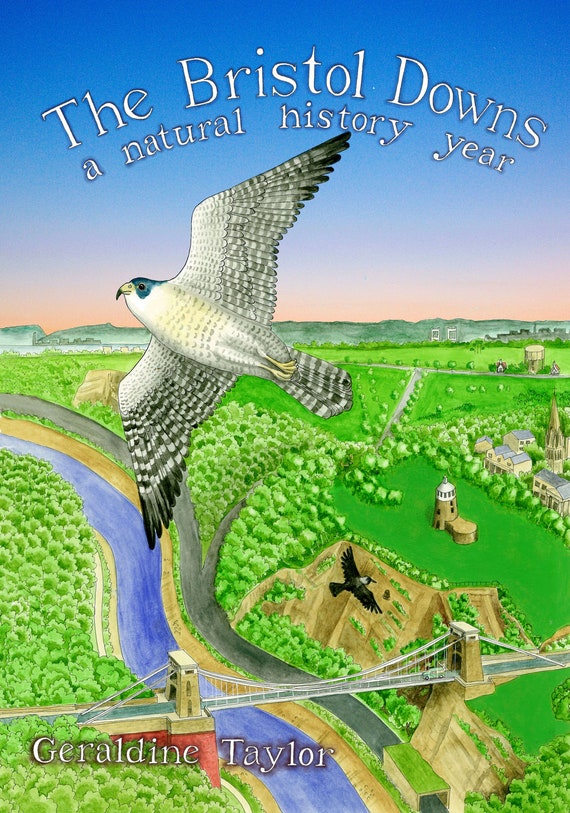
Among the books in the trailer was The Bristol Downs - a natural history year, which is now £5, and available at a good museum near you if you happen to be in Brizzle; or from my Etsy shop! Lots of pictures by me, and descriptions by Geraldine, of the birds, beasts, trees, fungus and plants of the area; and I wrote an introduction to the geology and history of the Downs, which you can read here. 


I also delivered a big box of Bristol and Ballooning, also £5, and just in time for this weekend's Balloon Fiesta.  Full of pictures of, er, Bristol and Ballooning. Info here. If you'd like a copy of it but can't get to Bristol, let me know and I'll stick some up on Etsy. Easy peasy.

I like it when the wind blows the balloons this way during the mass ascents. Sometimes they all descend on the Downs at the end of the road, like this


...and sometimes they go ghosting past, and I scramble up onto the roof and watch them go by


Thursday, 2 August 2012

cat sighs


cat sighs, originally uploaded by Dru Marland.
Cat sighs – and so would you,
stuck in the road where cars go through
with fat black tyres to squash them flat.
But they 're hardly ever put out by that,
they sighs a few sighs
wipes both eyes
then springs back to life like a cartoon cat.
.
John Terry*


Admiring Steve Marland's collages this morning, I recalled this one of mine from a few years ago. And since I've been doing a fair bit of travelling lately, here it is again. Life on the road.


*John wrote this in response to the photo, and e-mailed it to me just then. So I've added it here, because I like it. Thanks, John!


Wednesday, 1 August 2012

some mountains


 I was up in Crickhowell at the weekend, and walked up to Crug Hywel, or Table Mountain, at first light on Sunday. It's a good place to be on a summer morning like that one. A great flock of pipits rose up from the rocks on the south face of the hillfort, peeping as they went; I guess they were roosting there because the rocks were warm.

 I watched the sun making its way into the Grwyne and Usk valleys, eventually lighting up Crickhowell church, though Llanbedr was still in shadow when I went down again. I remembered the night I spent on Crug Mawr over there behind the sheep; the coldest night's camping I've ever had; we just huddled together, people, dogs (the dogs' own tent had blown down) and waited for morning, which took a long long time to arrive....

But that was then, and this is now. Or at least, Sunday. I drank the half bottle of Coca Cola I'd brought up for sustenance, and cooled down from the ascent. The sheep thought about it, and decided to ignore me. A buzzard called in the distance.

There were harebells in the meadow I dropped down through.

Heading home, I went up the side of Mynydd Llangatwg, on the steepest lane the Trav's ever been up. The engine temperature behaved itself. At the top, there's White Walls, a caving cottage where I got snowed in with the Portsmouth Poly Caving Club in 1980 (or thereabouts). We spent three days digging the minibus along the narrow mountain track, then dropping down to the pub in Llangattock in the evenings. As being snowed-in goes, it was pretty civilised.

That narrow mountain track goes round the top of the Clydach Gorge, to Brynmawr. Just short of Brynmawr, the way was blocked by a rescue lorry; someone had driven off the side, into the trees. So I had to turn round and go back. Still, they were lucky they hadn't gone off the road here, a few hundred yards further along the road.... it's a long way down, here.


I finally got to Mynydd Maen. Most of Hafod Fach, where I used to live, has been blasted into a quarry; but the big top meadow is still there, and had recently been cropped for the hay. I remembered sitting on this bank resting, grateful for a bit of shade, rather like we were doing here a few fields down.


Today I had the place to myself. The lane steamed in the after-rain sun. Somewhere out of sight a tractor was rumbling. I dropped down into Llanfach, past Llew Taylor's, where a jay flapped up from the gatepost and a three legged squirrel hobbled into the hedge. Heading for home.

Thursday, 26 July 2012

getting a bit hot


Folk who drive around in old old cars will be familiar with the occasional need to do something a bit proactive for the car's welfare. My parents recalled the traditional ritual of radiators boiling over on Shap Fell, before the M6 tamed that bit of Cumbria; for my part, no summer would be complete without our having chugged up Telegraph Hill on the A38 west of Exeter, at about 15 MPH, with a queue of frustrated motorists behind, all the windows open and the heater going full blast to try to keep the water temperature down.

I've been watching the temperature gauge closely for ages; I replaced the radiator four years ago, after some serious overheating resulted in a cracked cylinder head; everything was running fine until a few months back, and then I started to see the operational temperature creeping slowly upward. And this hot weather pushed it up beyond 90C the other day; and it's a real bind driving around with the heater on in a heatwave.

So I took the radiator out and backflushed it, and shook all the loose bits of matrix out, and hoovered the whole damn thing, and stuck it back. 

Situation improved, but I may install a summer thermostat; a 74C one arrived in the post yesterday....


Tuesday, 17 July 2012

bring back Bristol's Zil lane!


 There have been some changes on the local roads here in Bristol. Just around the corner from me, the Westbury Road (see picture)  has had one of its three lanes re-designated as a bus lane. In the screenshot above, you can see the former configuration. Between the White Tree roundabout and the Henleaze Rd junction (top left), the centre lane was divided between a right filter for the northbound traffic, and a right filter for the southbound traffic.

In this picture, typical of an off-peak traffic flow, we see

  • 14 cars in the southbound/left filter lane
  • 5 cars in the northbound lane
  • 2 cars in the northbound right filter lane
  • 0 cars in the southbound right filter lane

The southbound right filter lane did, though, prove to be very useful for people in a hurry. Never a journey would go by without my seeing someone charge down the right filter lane, then go straight across the roundabout, forcing their way into the southbound stream, a manoeuvre that involved a hard acceleration into the roundabout and close scrapes with both the cars using the correct lane procedure, and pedestrians using the zebra crossing that's just out of shot in the lower right corner.

It was quite a fun game, actually, guessing which car in the right hand lane would do it. White vans, taxis, Range Rovers, and anything black and shiny were, of course, top of the list of candidates; and, on the rare occasions that they actually did turn right, I would reflect that I should work harder at overcoming my prejudices. So it could be morally improving as well as entertaining.

Now, the entire middle lane is dedicated to southbound and right-turning traffic The southbound left hand lane is now the bus lane, with a left filter for non-bus lane traffic in the section close to the roundabout.  

 Driving south the other week, I was surprised to see a couple of people on the adjacent pavement, waving placards objecting to the bus lane and handing out leaflets inviting drivers to sign a petition. I was surprised, because the new road configuration seems to be a much better use of resources than the previous one.

And then I got an e-mail, also inviting me to sign the petition, with the explanation that


Hiya
I had this link passed to me by a Henleaze Parent. If you have a strong view about the new bus lane, the petition needs signing soon, as it closes on 19 July.
L**
I'm a parent, though only a lower-case one. I imagine that to qualify as a Henleaze Parent With A Capital P, you need to actually use a large car to take your children to school and to all their social engagements. This supposition was further reinforced when I looked at their Facebook page, where one commenter complains about the journey time to a Bristol school, from the motorway.Though obviously they're not a Henleaze Parent, other than in spirit.

I do have strong views, but the course of action that those views lead me to is not the signing of a petition. Unless it's a counter petition to say how good the bus lane is. Hence my writing this.

I replied to the e-mail, explaining my position. I was heartened to see another dissenting opinion expressed by S*****, who has found cycling along that section of road much better and safer than it had been (it's not on my normal cycling route, but on the one occasion I did go that way, I was favourably impressed too).

So.

People advantaged by the bus lane:

  • bus passengers
  • cyclists
  • taxi drivers

People disadvantaged by the bus lane

  • the chancers who used the old southbound right filter lane to queue jump
  • drivers turning right at the roundabout (a demonstrably low proportion of total traffic)

Gosh, that's a tough one!

postscript: The This bus lane is madness Facebook page doesn't seem to like dissenting voices; my friend Liz had her observations deleted. Mine lasted a little longer, but disappeared after an anti-bus lane driver (and evidently queue-jumper) apparently condoned illegal driving and put the blame for it at the door of the Council. Since it's so interesting, I reproduce it here.

SC: Once you were perfectly entitled to use the right-hand lane for the top of Black Boy (sic), before they changed the priority.

DM: ...looking at the historical imagery on Google Earth, the right-hand lane appears to have been consistently a right-filter since 1999, the earliest historical layer on GE.

SC: I think this is one of the unreported side effects of continual council interference - driver frustration that can then lead to people having contempt for the rules of the road. Its most obvious form is people jumping red lights (after the green period has been markedly reduced) which is getting more and more common. BCC is at fault here. They are a joke and a growing number of people are clearly ignoring their diktats. I've even seen people cutting corners by driving over the Downs.

DM: The belief that one is above the law is nothing new - do you remember that Cabinet Minister under Thatcher, who got nobbled for a flagrant disregard of the traffic regs, and gave his opinion that 'rules are for little people'? Who the heck was that? Refreshingly honest, anyway; and nice to hear similar frankness from you!