Showing posts with label wales. Show all posts

Friday, 1 March 2013

quantifiable welsh poem


I early learned that brontosauruses
Are long as three red London buses
And all the folk in China’ll quite
Fit upon the Isle of Wight.
Rare indeed's the object which is
Not compared with football pitches
But other places try and fail
To be as close a fit to Wales as Wales.

...inspired by this on the radio....

Wednesday, 7 October 2009

Alabaster Thomas


There's never enough time, is there? -today is National Poetry Day, and apparently the theme is Heroes and Heroines. So expect to see gossiping shoppers swapping sestinas, commuters quickly composing haiku, mechanics mouthing sonnets under bonnets. Heroically.

Or something.

My poem that I've been working on is still unfinished, but here it is, because when I put it up on the blog it will take up a life of its own and almost certainly sprout a good final verse. It's based on an encounter I had over in Wales last month.

"But what one will remember about New Bethel is the crowd of monuments in the BURIAL GROUND, and in particular the presumptuous memorial to James Thomas 1901, bearing a statue which overtops the chapel roof”

John Newman, Buildings of Wales: Gwent/Monmouthshire


Alabaster Thomas

Startlingly luminous there in the evening sunshine,
Mr Alabaster Thomas towers high above the tombs,
His haughty gaze fixed north to Pen y Fan on the horizon
Across New Bethel's rooftop cast in crepuscular gloom.

St Tudor's congregation saunter up to Mynyddislwyn;
Or sheep, come down for shearing, clatter down upon their way.
His gaze remains averted; other flocks are all alike to him
Intent to watch his chapel folk until the Judgement Day.

The crowded graves below him are both even and gregarious;
Grey Pennant slabs that huddle in the lee of the high wall.
Although his lofty pedestal is draughty and precarious
He scorns to turn his collar up and fears not the fall.

He has seen the hilltop slagheaps spread and grow above the pitheads
And the coal that fuelled an empire go to Newport Docks by rail
And the grass that spread and blanketed the slagheaps and the sidings
And the fires of Blackwood's foundries flare, and flicker out, and fail.

Rust upon the iron railings, creeping ivy on the masonry;
The roots of rosebay willowherb caress the resting skull;
The worms by now have long since tried that long-asserted dignity
Where the mouse that eats the blackberry takes refuge from the owl.
With the setting of the sun departs the glow of Alabaster-
He's just a deeper shadow now against the wheeling of the Plough.
Cars on the dual carriageway bring shoppers home from Asda
For dinner with the telly on then up the pub for after,
Time please, then car doors slamming, and the sound of distant laughter;
Then silence, and we say "Goodnight - but just for now..."


by the way, thanks to the wonder that is Street View, you can stand next to the chapel. But you won't see the sunset that Alabaster and I saw


View Larger Map

Saturday, 18 July 2009

a rum do

on Twyn Barlwm


I got an e-mail from David yesterday, about the Idris Davies poem Rhymney I uploaded last week. It was short and to the point:


pronounced as RUM_KNEE

...as an Englishwoman, albeit one who went to school in the Valleys, I hesitate to pronounce upon Welsh pronunciation. But... as I recall, Rh is pronounced differently to R; it is rolled, with lots of breath. Try reversing the letters, like this: Hrum-knee...

I once had to explain to Richard, by e-mail, how to pronounce the welsh LL. I found a useful description of it in my Welsh placenames book. "Like the TL in Bentley", it said. Which sort of works, although when Katie tried this explanation with some children in Nottingham when she introduced them to Llygoden, her toy mouse, they inserted a glottal stop and it came out as Ben_Lee.

Of course, there's proper pronunciation and there's pronunciation as it is pronounced. The locals were pretty casual about it in the Newbridge area, back in the 70s, and no-one spoke Welsh apart from the children of Mrs James, my English teacher, two of whose sons went to the Welsh school at Rhydfelen. So 'Celynen', for instance (the name of two local collieries: North Celynen and South Celynen) would be spoken 'Glennan'. This was in the Ebbw valley; I had the impression that things got progressively more Welsh as you travelled west.

Times change.

Here's a poem. I remember those hooters. (Nantgarw, by the way, is pronounced "Nant GAR oo") with the stress on the GAR, and a short 'a' sound as in 'ash')


Meic Stephens Hooters


Night after night from my small bed

I heard the hooters blowing up and down the cwm:

Lewis Merthyr, Albion, Nantgarw, Ty-draw —

these were the familiar banshees of my boyhood.


For each shift they hooted, not a night

without the high moan that kept me from sleep;

often, as my father beyond the thin wall

rumbled like the turbines he drove at work, I


stood for hours by the box-room window,

listening. The dogs of Annwn barked for me then,

Trystan called without hope to Esyllt

across the black waters. Ai, it was their wail


I heard that night a Heinkel flew up

the Taff and its last bomb fell on our village;

we huddled under the cwtsh, making

beasts against the candle’s light until the sky


was clear once more, and the hooters

sounded. I remember too how their special din

brought ambulances to the pit yard,

the masked men coming up the shaft with corpses


gutted by fire; then, as the big cars

moved down the blinded row on the way to Glyntaf,

all the hooters for twenty miles about

began to swell, a great hymn grieving the heart.


Years ago that was. I had forgotten

the hooters: my disasters, these days, are less

spectacular. We live now in this city:

our house is large, detached and behind fences.


I sleep easily, but waking tonight

found the same desolate clangour in my ears

that from an old and sunken level

used to chill me as a boy — the inevitable hooter


that paralyses with its mute alarm.

How long I have been standing at this window,

a man in the grown dark, only my wife

knows as I make for her white side, shivering.


Monday, 6 July 2009

poetry of Idris Davies

There doesn't seem to be much of Idris Davies' poetry on the internet, so I've uploaded these, some of which are in "This World of Wales - an anthology of Anglo-Welsh poetry", ed. Gerald Morgan, and others gleaned here and there.


(You might also like this poem by Meic Stephens, about colliery hooters; I do! And here is Alabaster Thomas, my own Valleys poem)


Gwalia Deserta VIII


Do you remember 1926 ? That summer of soups and speeches,

The sunlight on the idle wheels and the deserted crossings,

And the laughter and the cursing in the moonlight streets?

Do you remember 1926 ? The slogans and the penny concerts,

The jazz-bands and the moorland picnics,

And the slanderous tongues of famous cities?

Do you remember 1926 ? The great dream and the swift disaster,

The fanatic and the traitor, and more than all,

The bravery of the simple, faithful folk?

‘Ay, ay, we remember 1926,’ said Dai and Shinkin,

As they stood on the kerb in Charing Cross Road,

“And we shall remember 1926 until our blood is dry.”


Gwalia Deserta XV


O what can you give me?

Say the sad bells of Rhymney.


Is there hope for the future?

Cry the brown bells of Merthyr.


Who made the mineowner?

Say the black bells of Rhondda.


And who robbed the miner?

Cry the grim bells of Blaina.


They will plunder willy-nilly,

Say the bells of Caerphilly.


They have fangs, they have teeth

Shout the loud bells of Neath.


To the south, things are sullen,

Say the pink bells of Brecon.


Even God is uneasy,

Say the moist bells of Swansea.


Put the vandals in court

Cry the bells of Newport.


All would be well if — if — if —

Say the green bells of Cardiff.


Why so worried, sisters, why

Sing the silver bells of Wye.


Morning Comes Again

Morning comes again to wake the valleys
And hooters shriek and waggons move again,
And on the hills the heavy clouds hang low,
And warm unwilling thighs crawl slowly
Out of half a million ruffled beds.
Mrs Jones' little shop will soon be open
To catch the kiddies on the way to school,
And the cemetery gates will chuckle to the cemetery-keeper,
And the Labour Exchange will meet the servant with a frown.

Morning comes again, the inevitable morning
Full of the threadbare jokes, the conventional crimes,
Morning comes again, a grey-eyed enemy of glamour,
With the sparrows twittering and gossips full of malice,
With the colourless backyards and the morning papers,
The unemployed scratching for coal on the tips,
The fat little grocer and his praise for Mr Chamberlain,
The vicar and his sharp short cough for Bernard Shaw,
And the colliery-manager's wife behind her pet geranium
Snubbing the whole damn lot!


Mrs. Evans fach, you want butter again

Mrs. Evans fach, you want butter again.
How will you pay for it now, little woman
With your husband out on strike, and full
Of the fiery language? Ay, I know him,
His head is full of fire and brimstone
And a lot of palaver about communism,
And me, little Dan the Grocer
Depending so much on private enterprise.

What, depending on the miners and their
Money too? O yes, in a way, Mrs. Evans,
Come tomorrow, little woman, and I'll tell you then
What I have decided overnight.
Go home now and tell that rash red husband of yours
That your grocer cannot afford to go on strike
Or what would happen to the butter from Carmarthen?
Good day for now, Mrs. Evans fach.


Tiger Bay


I watched the coloured seamen in the morning mist,

Slouching along the damp brown street,

Cursing and laughing in the dismal dawn.

The sea had grumbled through the night,

Small yellow lights had flickered far and near,

Huge chains clattered on the ice-cold quays,

And daylight had seemed a hundred years away...

But slowly the long cold night retreated

Behind the cranes and masts and funnels,

The sea-signals wailed beyond the harbour

And seabirds came suddenly out of the mist.

And six coloured seamen came slouching along

With the laughter of the Levant in their eyes

And contempt in their tapering hands.

Their coffee was waiting in some smoke-laden den,

With smooth yellow dice on the unswept table,

And behind the dirty green window

No lazy dream of Africa or Arabia or India,

Nor any dreary dockland morning,

Would mar one minute for them.


High Summer on the Mountains


High summer on the mountains

And on the clover leas,

And on the local sidings,

And on the rhubarb leaves.


Brass bands in all the valleys

Blaring defiant tunes,

Crowds, acclaiming carnival,

Prize pigs and wooden spoons.


Dust on shabby hedgerows

Behind the colliery wall,

Dust on rail and girder

And tram and prop and all.


High summer on the slag heaps

And on polluted steams,

And old men in the morning

Telling the town their dreams.


A Victorian Portrait


You stood behind your Bible
And thundered lie on lie,
And your roaring shook your beard
And the brow above your eye.

There was squalor all around you
And disaster far ahead,
And you roared the fall of Adam
To the dying and the dead.

You built your slums, and fastened
Your hand upon your heart
And warned the drab illiterate
Against all useless art.

And you died upon the Sabbath
In bitterness and gloom,
And your lies were all repeated
Above your gaudy tomb.


Capel Calvin

There's holy holy people
They are in capel bach-
They don't like surpliced choirs,
They don't like Sospan Fach.

They don't like Sunday concerts,
Or women playing ball,
They don't like Williams Parry much
Or Shakespeare at all.

They don't like beer or bishops,
Or pictures without texts,
They don't like any other
Of the nonconformist sects.

And when they go to Heaven
They won't like that too well,
For the music will be sweeter
Than the music played in Hell.

Poem 18

Man alive, what a belly you've got!
You'll take all the serge in my little shop.
Stand still for a minute, now, and I'll get your waist.
Man alive, what a belly you've got!
Oh, I know it's only a striker's pay you get,
But don't misunderstand me, Hywel bach;
I depend for my bread on working men
And I am only a working man myself
Just Shinkin rees the little tailor,
Proud of my work and the people I serve;
And I wouldn't deny you a suit for all the gold in all the world.
Just pay me a little each week, Hywel bach,
And I am your tailor as long as you live,
Shinkin Rees your friend and your tailor,
Proud to serve you, and your dear old father before you.
But man alive, what a belly you've got!


A Victorian Portrait


You stood behind your Bible
And thundered lie on lie,
And your roaring shook your beard
And the brow above your eye.

There was squalor all around you
And disaster far ahead,
And you roared the fall of Adam
To the dying and the dead.

You built your slums, and fastened
Your hand upon your heart
And warned the drab illiterate
Against all useless art.

And you died upon the Sabbath
In bitterness and gloom,
And your lies were all repeated
Above your gaudy tomb.


Tuesday, 3 June 2008

bright field

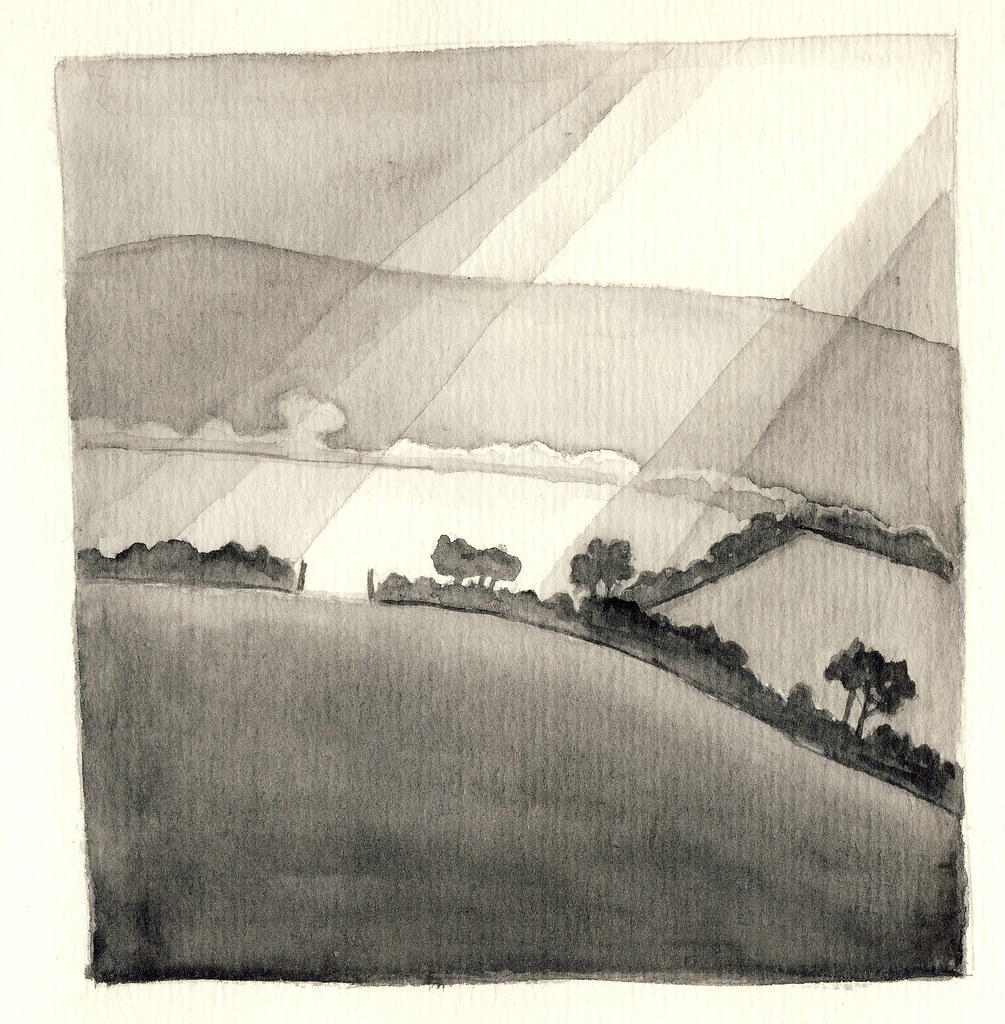
Not feeling very bright at the moment; I think that I'm having a reaction from all the activity of the last couple of weeks. So in lieu of any great thoughts, this is a picture I did to accompany a poem by R S Thomas. It's a sort of South Wales picture. We'd have been doing the haymaking at this time of year, back on the farm, and relaxing in the shade of the hedges with bottles of Newcastle Brown. Sometimes I'd find old bottles in the hedgerows, thrown there by the people doing the same work fifty, a hundred years before.

Farm's gone, blasted away by a quarry company. I read this poem to my father as he lay dying, six years ago.

The Bright Field

I have seen the sun break through
to illuminate a small field
for a while, and gone my way
and forgotten it. But that was the pearl
of great price, the one field that had
treasure in it. I realize now
that I must give all that I have
to possess it. Life is not hurrying

on to a receding future, nor hankering after
an imagined past. It is the turning
aside like Moses to the miracle
of the lit bush, to a brightness
that seemed as transitory as your youth
once, but is the eternity that awaits you.