Wednesday, 30 September 2009

Hardbacks

What with all the talk of libraries and classification lately, here's an apposite poem from John Terry.


Hardbacks


The books you’ve requested

are certainly here – but since

our Index altered itself


the stock moves at random.

Whole shelves of books

will vanish, then reappear


in a different section. You

have entered an area

where high Index numbers


frequently auto-accelerate

beyond their Critical Library

Mark. You can expect Flutter,


Disordered Page Syndrome

and complete Control Reversal.

Our librarians are fully trained


in runaway system management,

but Health and Safety insist

that borrowers must wear


protective dust-jackets at all times.

Some of our more rugged volumes

will not hesitate to read you like a book.

Monday, 28 September 2009

more about Bristol's eskimos


Callicho

'Ignorth' and the baby


I was quite excited to find out about the three Inuit brought to Bristol by Martin Frobisher in 1578; he'd captured them as hostages against the return of members of his crew who had been captured by the locals, and were not seen again. So he brought them back with him, and they died not long after. A post-mortem showed that the man, Callicho, had sustained broken ribs, presumably at the time of his capture by a crewman who was a Cornish wrestler. He was buried at St Stephen's church in Bristol; the woman, Ignorth (though the name is simply based on the Inuit for 'woman'), was present at the burial, as they wanted to reassure her that they weren't going to eat Callicho. It was observed that she appeared expressionless. She died soon after. The baby was sent to London to be presented to the Queen, but died before getting to court.


the view from the specimen jar

After a nice weekend in deepest Oxfordshire, I'm shuffling pieces of paper around and wondering where this week will go. To start with, let's look at the state of play with the Campaign To Rescue Books With Transsexual Content From Stupid Categories In The Dewey System.

Must think of a snappier and acronym-friendly title. Hmm.

Anyway.

As mentioned earlier, it appears that biographies and autobiographies of people with a transsexual history tend to get lumped into Social Sciences: Culture and Institutions. That's if they're lucky. If they aren't, they might well find themselves among the paedophiles over at Mental Health: Personality Disorders.

Previous posts are here, here and here.

I have written to Bristol Library, whose stock officer accepted that the latter category 'is now incorrect and unacceptable', but stated that Becoming Drusilla, the book in which I have an interest, is about a change of sex, and is therefore correctly assigned to 306.768, where it can presumably be studied by students of social science. He expressed the hope that it clarified things for me.

Alas, it did not, as my reply explained.

But answer (from Bristol library) came there none. And two weeks later, Jan Morris' Conundrum is still listed in the 'incorrect and unacceptable' 616.858 category in the library catalogue.

I still await a reply from the British Library.

Thanks, though, to SteveL, who posted the link to this article, which deals with ways of ordering information, and which introduced me to the word ontology, which is a good word.

I feel rather less alone when I realise that 'othering' is an inevitable side-effect of hierarchical ordering, performed by 'experts', as in the Dewey System; here, for instance, is the category Religion

Dewey, 200: Religion
210 Natural theology
220 Bible
230 Christian theology
240 Christian moral & devotional theology
250 Christian orders & local church
260 Christian social theology
270 Christian church history
280 Christian sects & denominations
290 Other religions
...can you see what it is yet? -as Rolf Harris used to say....

As Nose In A Book commented,
I assume there is a biography section in the Dewey system? What's in there? Perhaps it's considered lazy to use it; not trying hard enough.

How come plays all get classified under 'plays'? Perhaps Hamlet should get moved to 'mental health disorders'. Most of David Hare's output could go under 'politics'...
Indeed.


Friday, 25 September 2009

sart innit

I was in the Museum the other day, looking at some drawings. It was nice to be able to get in there again, after the long summer of the Banksy exhibition, and I popped upstairs to say hello to the stuffed animals, several of which have found their way into my own drawings.

And then I met Sandra and had a cup of tea while talking about Banksy and stuff. Sandra thought that it was a Good Thing that the museum had thrown its doors open to Banksy, as his stuff is very Now, and Vernacular, and Street. (I hope I'm not misrepresenting you too much, S...). I'm less sure; it seemed to me a bit like repressive tolerance. Out on the streets, the City Council no longer automatically paint over graffiti; they must first determine whether it is art. And if it is art, it stays. At least, if the people who are paid to determine whether it is art, say that it is.

Coincidentally, young Katie was recently fizzing and popping about developments at school.

Last year, the children had asked for a graffiti wall.

They have finally been granted one.

A graffiti artist was paid to come in and paint the graffiti wall for them.


Thursday, 24 September 2009

eskimos in Bristol


John Lee has been putting interesting stuff about Elizabethan Bristol onto a Google map, and I've been looking out for things to add to it too.

Here is the map...


View Elizabethan and Jacobean Bristol in a larger map


I was impressed with the story of how the people who were burning the Protestant martyrs, during the reign of Bloody Mary, trekked up the hill to Redland to get green timber for the fire, so that the men they were burning would die more slowly and painfully, rather than use the more readily-to-hand seasoned timber available.

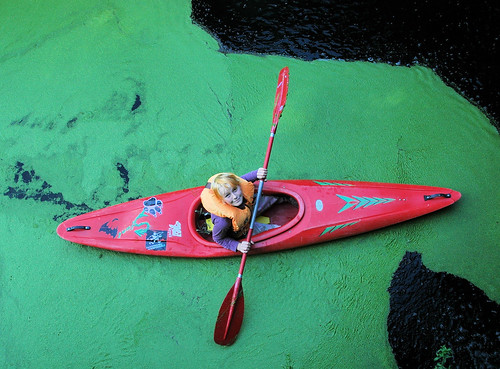
And I discovered what was almost certainly the very first kayak to ply the waters of Bristol Harbour, paddled by an Eskimo who was brought here by Martin Frobisher after his failed attempt to find the North West Passage.


“In (b) the year 1578 a great ship of our Queen’s called the Aid, al’ the Ann of 2OO tons [with a small barque, R’ R’] came into Kingroad from Cattaie, Martin Forbisher being captain of her, after having attempted to find the North-west passage to the East-Indies, China, and Cattay. She brought certain ore, which was esteemed to be very rich and full of gold; heavy and so hard that it would strike fire like a flint. Some of it was tried in our castle, and the rest sent to London, where it was esteemed not worth the charges in refining. They brought with them a man of that country called Callicho [al’ Cally Chough] with his wife, called lgnorth, and a child. They were savage people, clothed in Stag’s skins, having no linen nor woollen at all, and fed only upon raw flesh: she suckled her child, casting her breasts over her shoulders. Oct’ 9th, he rowed up and down the river at the Back of Bristol, it being high tide of sea, in a boat, the which was about fourteen feet long, made of skins, in form like unto a large barge or trow, but sharp at both ends, having but one round place for him to sit in; and as he rowed up and down he killed a couple of ducks with his dart; and when he had done he carried away the boat through the Marsh on his back. The like he did at the Weare, and at other places. Within one month they all three died. [These were Greenlanders or Eskimaux.) Also on May 31st, the said captain Forbisher set out on another voyage to Cathay; but he returned without success.”

quoted in Memoirs Historical and Topographical of Bristol and its Neighbourhood, Rev. Samuel Sayer, 1823

(this story is continued here)

Tuesday, 22 September 2009

torpedo run

I knew that if we didn't finally get out and go canoeing over the weekend, what with the weather being so perfectly autumnal and all, then I'd be spending the time till next autumn lamenting a lost opportunity. So I prised Katie away from her computer and off we went.

Past the city limits and heading south, we were approaching the big roundabout where the A4 meets the ring road and the road to Keynsham. I started to slow down. The nose of the yellow kayak up on the roof appeared in our field of vision at the top of the windscreen. I eased off the brakes as much as possible, but there was a queue of cars ahead waiting to enter the roundabout, and I had to slow down. Katie and I watched, fascinated, as the kayak continued to advance. Then it launched itself off the roof and down our starboard bow onto the road, bouncing enthusiastically along the centre lane as I banked hard to port to get as close to the side as possible. It was really quite dramatic. It would have been like the bit in Sink The Bismarck, where the Swordfish go in with their torpedos, if their torpedos had been great big yellow things on the Swordfishes' roofbars. And the Swordfish had been Morris Travellers, of course.

Katie went into her hoping-the-ground-would-swallow-her-up mode, which she's getting quite good at. I leapt out, gestured frantically at the cars speeding towards me to encourage them not to mow me down (though they were probably discouraged from doing so by the Big Yellow Kayak, anyway) and hauled it to the side of the road and thus back onto the roof, where I added a rope noose around its snout to discourage any further escape bids.


We paddled along the Kennet and Avon canal, which was both busy with narrowboats and a bit narrow too, so that Katie pranged badly into a thicket of brambles, and had to be rescued. She was rapidly developing a detestation of all things kayak, when fortunately we reached the Dundas aqueduct, and descended to the River Avon, which was wide and placid and entirely devoid of other boats.

This was what we had come for. A kingfisher flew ahead of us. We paddled through a family of swans, all smacking water around in their beaks like wine tasters; TCHTCHTCHTCHTCH. And there was a conker tree hanging right over the water, the conkers just waiting to be plucked from the split shells hanging on the boughs. Heavened with conkers.

That is what we'll remember, for longer than the wet bums and the brambles. Well, hopefully.


Monday, 21 September 2009

letter to the British Library

a copy of today's e-mail to the British Library

21st September 2009


To: British Library


Dear Sir or Madam,


I have been looking at the way that books about transsexual people have been classified by the British Library using the Dewey Decimal System. Some decisions appear to have been made in the past that, to a contemporary eye, can appear at least questionable and sometimes plain wrong, as I hope you will agree when I highlight them.


Perhaps the best-known autobiography of a transsexual woman, Jan Morris’ Conundrum (1974), has been assigned to 616.85, Diseases: Personality Disorders. I find that in the British Library catalogue, the book is placed between two volumes entitled respectively Clinical Aspects of the Rapist and Perversion. Similarly, Duncan Ashwell’s book April Ashley’s Odyssey (1982) may be found between Adult Sexual Interest in Children and The Child Molester. There can surely be no doubt that they do not belong there.


There is, of course, a category for Transsexuality; though the position of that category within the Dewey system is itself questionable, as a sub-group of 306.7 (Culture and Institutions: Sexual Relations). Transsexuality is a condition related to gender identity, and not a mental disorder; it is not a cultural phenomenon, and has nothing to do with sexual relations. However, accepting that, as a topic, it has to exist somewhere, surely this is a section which should deal with the condition itself? There are books dealing with the medical, social, and even political aspects of transsexuality; and they are indeed in this section, and perhaps rightly so.


But I would argue that, in biography, transsexuality may be an element, and even an important element, of a subject's life; but it is not the defining element. And I am concerned that, by placing biographies of people with a transsexual history into the 306.768 category, those people are being 'othered'. This can and does happen in everyday life, where some people are too ready to see the 'transsexual' in the individual to notice that they are in fact just people too: and, in doing this, they marginalise, exoticise, isolate and even persecute them.


It was at least in part to address these concerns that I worked with Richard Beard on the book "Becoming Drusilla", and it seems sadly ironic that this book has been pigeonholed as it has been (306.768092), when the subject matter is as much the biographer as the biographee; and the book is as much a travel book as it is a biography; and, where it is a biography, it is concerned with a whole life rather than a ‘sex change’.


I should be most grateful if you would review the categorisation of these books, and the other books in your collection which may have suffered a similar fate.


Yours sincerely,


Ms Drusilla Marland